The Policy Changed Last Week. Did Your AI Agent Notice?
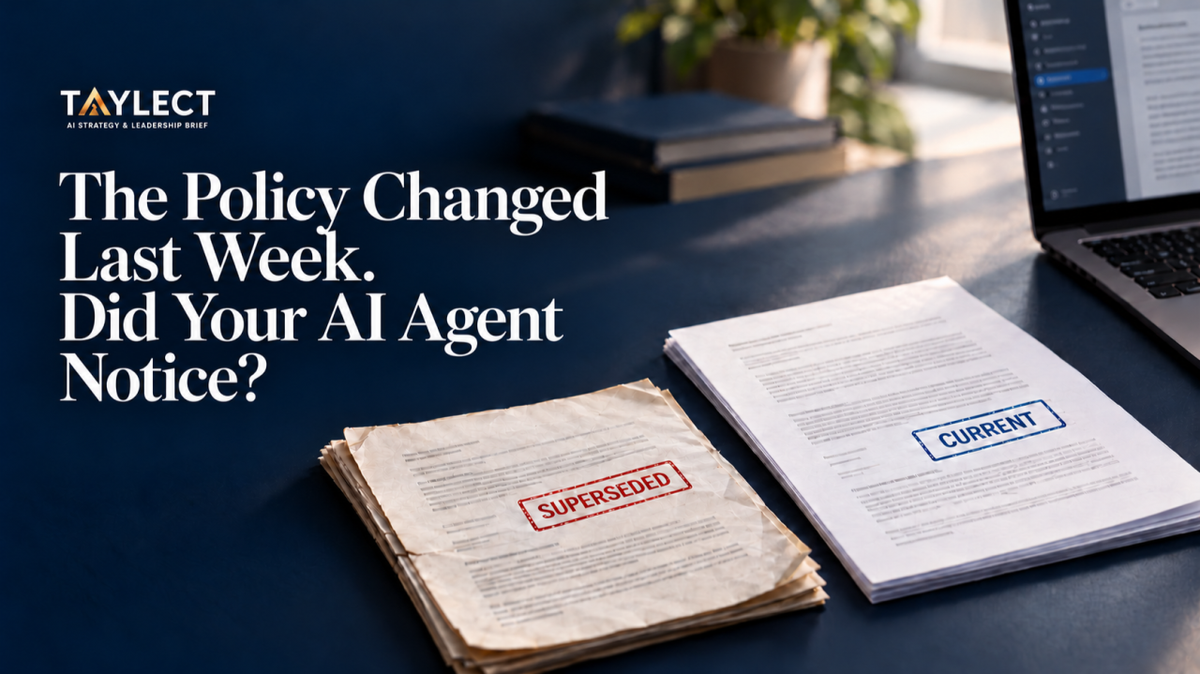
An agent can follow its instructions perfectly and still act on information your organization should have retired.
Executive Brief
The Signal: On October 6, Atlassian and OpenAI expanded their partnership to connect frontier models with Atlassian's Teamwork Graph, the layer linking people, projects, documents and decisions. Two days later, Google announced a Gemini agent for work with its own enterprise context and governance capabilities. Both moves push AI deeper into organizational knowledge, making the freshness of that knowledge a leadership question, not an IT one.
Why It Matters: A citation proves where an answer came from. It doesn't prove the source is still authoritative. An agent can follow its instructions perfectly, cite a real document, and still hand someone outdated guidance because nobody told it the policy changed.
The Leadership Decision: Before expanding an agent's access to more of the organization's knowledge, leaders need to settle five things: authority, ownership, freshness, retirement and escalation. Without them, the agent is left resolving ambiguities the organization itself never resolved.
Imagine an employee asks an AI agent whether a particular expense requires approval.
The agent retrieves a policy, cites the relevant section and provides a clear answer. The response looks trustworthy. It has a source. It follows the instructions. Nothing appears invented.
There is just one problem. The policy changed last week. The agent answered correctly based on a document the organization should no longer use.
Enterprise context is becoming part of the product.
These announcements don't establish that agents consistently deliver better business outcomes. They do show where vendors are directing their enterprise offerings: toward AI that works with organizational context and participates in workflows.
That makes maintaining that context a leadership concern.
A document that once helped an employee interpret a process may now inform an agent's recommendation, or an action taken through a connected system. Its accuracy, authority and freshness become part of the conditions under which work is delegated.
A citation is the first step in verification.
Organizations rightly want agents to cite their sources. But a citation shows where information came from. It does not, by itself, establish that the source is current, approved or applicable to the situation.
A recently uploaded document may contain an old policy. An older document may remain the authoritative standard. A project discussion may record a proposal that was never approved.
Freshness therefore means more than checking a timestamp. It means knowing whether information remains valid for the decision being made.
Consider a launch-readiness agent. It finds a completed checklist and recommends proceeding. Yet the risk owner subsequently added a requirement in another system. Both records may be authentic. The organization still needs a rule for which one governs the decision. Without that rule, the agent must resolve an ambiguity that people have left unresolved.
Knowledge ownership must continue after deployment.
The employee configuring an agent may understand its instructions and connections. That does not make them accountable for every policy, procedure or business decision it retrieves.
The relevant business owner must remain responsible for the knowledge approving authoritative sources, identifying changes, withdrawing superseded guidance, and resolving conflicts.
The agent owner has a related responsibility: ensuring those changes reach the agent's knowledge environment, and checking whether its responses reflect them.
Those responsibilities need a working connection. Otherwise, a business team can update a policy while the agent continues answering from an obsolete copy.
Five decisions leaders should make
Before expanding an agent's access to organizational knowledge, leaders should establish five things.
- Authority. Which source governs when documents disagree? A draft, a meeting note and an approved policy should not carry equal weight.
- Ownership. Who can confirm that information is correct and authorize its replacement?
- Freshness. What triggers a review? Scheduled checks help, but policy changes, incidents and material business decisions may require immediate updates.
- Retirement. How does superseded information leave the agent's usable knowledge? Publishing a replacement isn't enough if the old version remains available without a clear status.
- Escalation. What should the agent do when sources conflict, validity is uncertain, or approval can't be established?
For a small business, this may be one approved procedures folder, named owners and a simple change log. For an enterprise, it may require coordination across repositories, business functions and control teams. The underlying discipline is the same.
An agent doesn't need access to every document to be useful. It needs dependable access to the knowledge appropriate to its role, and a way to recognize when that knowledge is insufficient. That is why knowledge management belongs in agent readiness, ongoing monitoring and business ownership, not just in the initial build.
Before connecting another repository, choose one important question your agent answers. Trace the answer to its source. Identify the owner. Check how a change would reach the agent. Decide what happens if the source becomes uncertain.
Key Insight
Your agent's knowledge should have an owner, a validity status and a path for change.
The Question
If the policy changed yesterday, who ensures your agent gives the right answer today?
And on a more personal note, when's the last time you checked whether something you relied on this week- a template, a process, a number- was still the current version before trusting it?
One Resource Worth Your Time
Atlassian and OpenAI Grounding Frontier Intelligence in Enterprise Context
This is the primary announcement behind the Signal above, and it's worth reading directly rather than through secondhand coverage. It's one of the clearest public statements yet of how vendors are thinking about grounding AI in organizational context, which is exactly the terrain where the ownership, freshness and retirement questions in this edition actually get decided.
openai.com/index/atlassian-partnership
AI is not a technology race.
It is a decision-making advantage.
The organizations that get this right won't have the smartest agents. They'll have the agents that know what's actually still true.
Execution, not experimentation, will define the next phase of AI.
Dwayne Taylor, Founder & Editor, Taylect
Comments ()