
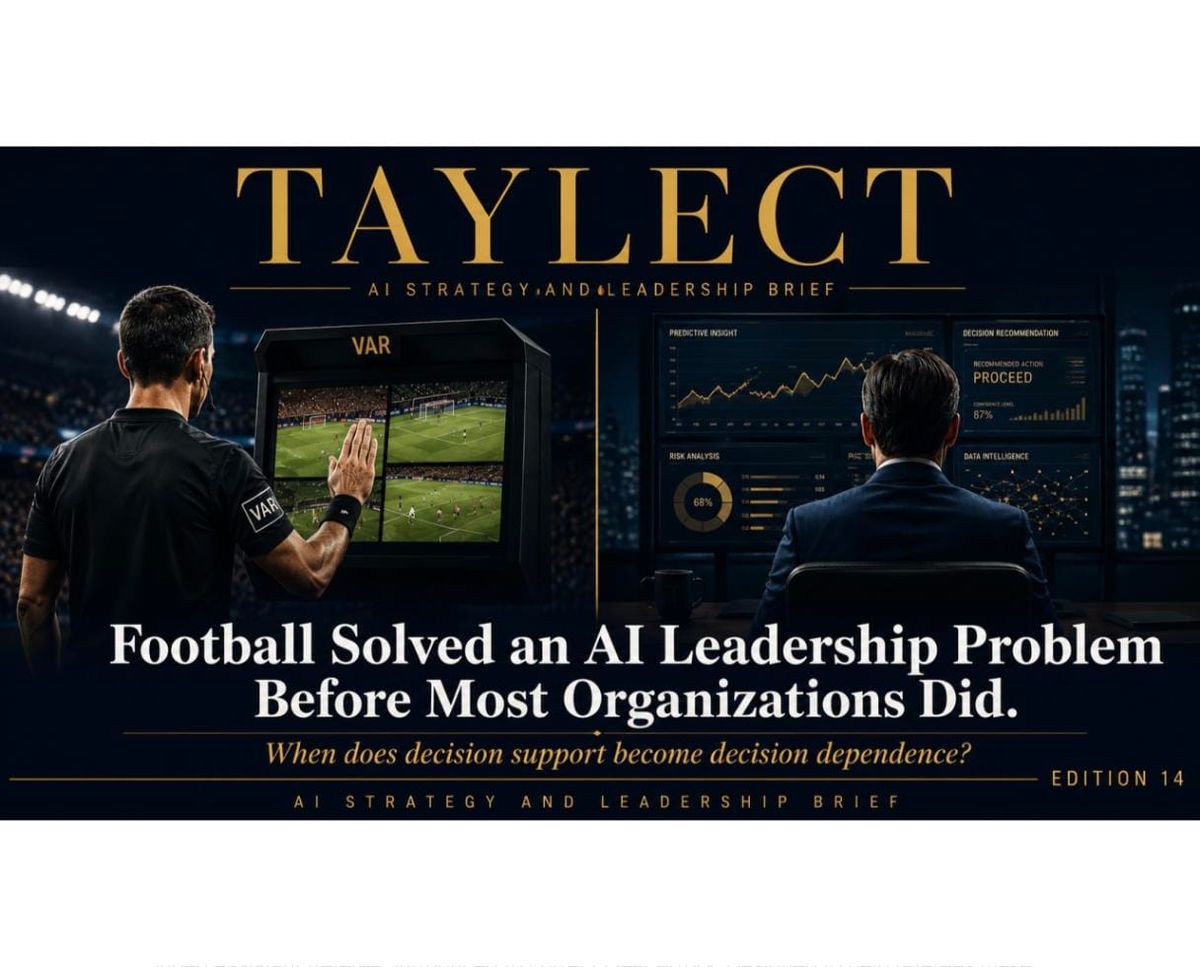
Football Solved an AI Leadership Problem Before Most Organizations Did.
VAR promised better decisions in football. Instead it eroded referee judgment through three quiet stages: decision support, decision expectation, decision dependence. Enterprise AI is following the same path — and most leaders haven't defined where it stops.
Edition 14 · Where AI Strategy Becomes a Leadership Advantage
VAR didn't change the game. It changed decision-making. And enterprise AI is following the same path.
In an era of constant AI noise, leaders don't need more information; they need clarity.
If you follow football, you already know VAR.
Video Assistant Referee. Introduced to correct clear errors. Designed to help referees make better decisions in the moments that matter most: goals, penalties, red cards, mistaken identity.
The promise was simple. Better information. Better decisions. Fairer outcomes.
Sound familiar?
Before VAR arrived, referees owned their decisions completely. A goal was a goal. A penalty was a penalty. The human on the pitch had the final word, and that was the end of it.
Then VAR changed everything.
Not by replacing the referee.
By changing what it means to decide at all.
The Question VAR Made Impossible to Ignore
Here is a thought that has stayed with me since VAR was introduced.
How many goals did we celebrate before VAR existed that were not actually goals?
How many penalties were awarded that should never have been given? How many players were sent off on mistaken identity? How many matches turned on decisions that, under VAR-level scrutiny, would have been overturned?
We will never know.
But the question reveals something important.
The introduction of better technology does not only change future decisions. It retroactively calls into question every decision made before it existed.
Now apply that to your organization.
How many strategic decisions, hiring decisions, credit decisions, clinical decisions, or operational decisions made before AI arrived would look different under AI-level analysis today?
That is not a technology question.
It is a leadership question about the quality of judgment that existed before augmentation arrived and what responsibility leaders carry for the decisions made without it.
Why VAR Was Introduced
Referees are human. Human judgment is imperfect. Football at the highest level moves faster than any human can process with complete accuracy. A split-second decision on a goal-line incident, a penalty appeal, or an offside call carries enormous consequences for clubs, for careers, for championships.
VAR was the answer to a problem that had always existed but had never been solvable before the technology arrived.
The same logic is driving AI adoption inside organizations today.
Leaders are human. Human judgment is imperfect. Business at the highest level moves faster than any leadership team can process with complete accuracy. Decisions about risk, customers, operations, and strategy carry enormous consequences for organizations, for employees, for markets.
AI is the answer to a problem that had always existed but was never solvable before the technology arrived.
The parallel is precise.
And the lesson football learned the hard way is one that most organizations have not yet absorbed.
What VAR Actually Changed
VAR was designed to improve decisions. And in measurable terms it has. Fewer incorrect goals stand. Fewer wrongful red cards are issued. The accuracy of officiating at the highest level has improved.
But something else happened that nobody fully anticipated.
VAR changed how decisions are made, not just whether they are correct.
Before VAR, referees made calls with confidence. They were trained to decide quickly, to commit, and to move on. The game depended on it. That confidence was not arrogance. It was the learned capacity to exercise judgment under pressure without the luxury of review.
After VAR, something shifted.
Referees began to hesitate. Not because they became less capable, but because the existence of a review system changed the psychology of the decision itself. Why commit fully when VAR might overturn you? Why trust your instinct when the camera sees more than you do?
Players began to appeal every decision rather than accept it. Managers began to question every call. Fans began to withhold celebration until VAR confirmed the goal. The authority of human judgment on the pitch did not disappear overnight. It eroded quietly, incrementally, without anyone making a deliberate decision to let it happen.
That erosion is the lesson.
The Three Stages Every Organization Needs to Recognize
What VAR illustrated is a progression that enterprise AI is now replicating inside organizations across every industry. It moves through three stages, and most organizations do not notice the transition until they are already in the third one.
Stage one — Decision support. The tool provides better information. The human decides. AI surfaces the data, the pattern, the recommendation. The leader evaluates it, applies judgment, and makes the call. The technology is genuinely augmenting capability. This is where every AI deployment begins and where most organizations believe they permanently remain.
Stage two — Decision expectation. The tool becomes assumed. Decisions feel incomplete without it. Leaders begin to delay judgment until the AI output arrives. Teams stop trusting analysis that was not AI-assisted. The technology has moved from a resource that supports decisions to a prerequisite for making them. The human still decides but only after AI has spoken first.
Stage three — Decision dependence. The human defers. Judgment atrophies. When AI recommends a course of action, the path of least resistance is to follow it. Overriding AI requires justification. Agreeing with AI requires none. Over time, the muscle of independent judgment weakens — not because anyone decided it should, but because the environment made exercising it increasingly unnecessary.
Most organizations deploying AI today believe they are firmly in stage one.
Many are already in stage two.
Some are closer to stage three than they realize.
The question is not which stage you are in.
It is whether you have defined — deliberately and in advance — the conditions under which human judgment overrides AI, and the conditions under which AI informs human judgment without replacing it.
VAR never fully answered that question before deployment.
Most organizations have not answered it either.
What This Means for Leaders
The referee on the pitch today does not make decisions alone. They make decisions inside an ecosystem of cameras, algorithms, protocols, replay officials, earpieces, and communication systems. The human still decides. But the environment in which that decision is made has fundamentally changed.
Leaders today are in the same position.
They do not make decisions alone. They make decisions surrounded by copilots, agents, dashboards, recommendations, predictive models, and AI-generated analysis. The human still decides. But the environment has fundamentally changed.
The danger is not that AI will make the decision.
The danger is that leaders will stop exercising the judgment required to make it well.
Three things every leader should define before the next AI deployment: what decisions remain exclusively human, where AI informs but cannot recommend an override; what conditions allow AI to challenge human judgment, and what evidence threshold that challenge requires; and what happens when the leader and the AI disagree, and who is accountable for the outcome either way.
VAR had answers to none of these questions before it went live.
The controversy that followed was not a technology failure.
It was a governance failure.
This Week's Challenge
Think about the AI tools currently informing decisions inside your organization.
For each one are you in stage one, stage two, or stage three?
And for the decisions where AI has the most influence — have you defined in writing what happens when human judgment and AI recommendation disagree?
Drop your answer in the comments. I read every one.
If this reframes how you think about AI and decision-making in your organization, share it with one leader who is deploying AI without answering these questions first.
If you are not yet subscribed to Taylect: taylect.com — every week one sharp analysis of AI strategy, governance, and leadership. Written from the practitioner's perspective. No hype. Just clarity.
The conversation Canada needs about AI is not happening loudly enough. Taylect is here to change that.
One Resource Worth Your Time
The International Football Association Board, the body that governs the laws of football, published its most recent review of VAR implementation in 2025, documenting what worked, what did not, and what governance gaps allowed the technology to drift from its original mandate. For any leader navigating AI deployment, this report reads less like a football document and more like a warning.
AI is not a technology race. It is a decision-making advantage.
The organizations that succeed won't be the ones with the most AI. They will be the ones whose leaders still know how to decide when AI disagrees.
Execution, not experimentation, will define the next phase of AI.
Dwayne D. Taylor, Senior Manager, Data Products Excellence & Innovation — Scotiabank, MBA Candidate, AI Leadership — University of Fredericton, Publisher, Taylect: AI Strategy and Leadership Brief
The views expressed are my own and do not reflect those of my employer.

Comments ()