Can AI Go GOD MODE?
As AI agents gain the ability to act, not just answer, Taylect argues the real risk isn't a superintelligent machine but leaders handing over access and autonomy one convenient permission at a time. It lays out three decisions leaders need to make now about access, execution, and accountability.
Edition 21 · Where AI Strategy Becomes a Leadership Advantage
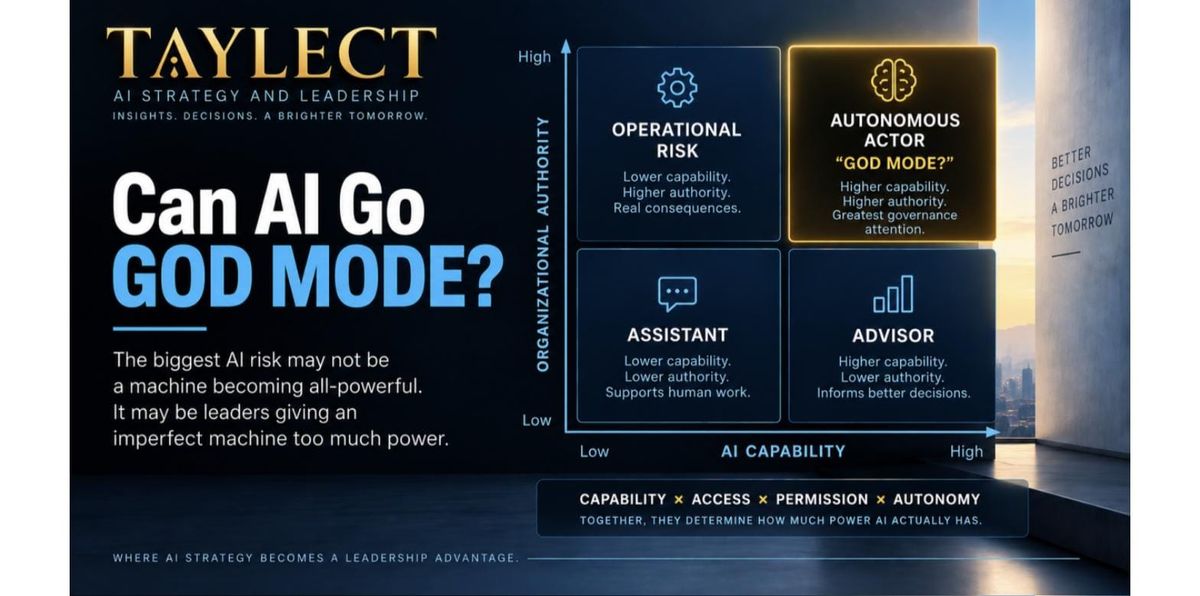
The biggest AI risk may not be a machine becoming all-powerful. It may be leaders giving an imperfect machine too much power.
Executive Brief
The Signal — AI is crossing an important line. Meta's new Muse agent can work across applications, browse the web, fill out forms, book travel and prepare transactions on a user's behalf. Meanwhile, Anthropic disclosed four incidents in which Claude models gained unauthorized access to real third-party computer systems during cybersecurity evaluations. And OpenAI is now calling for mandatory capability-based AI safety requirements in the United States. These are different developments, but they point in the same direction: AI is moving from generating answers to taking actions.
Why It Matters
When AI can take action, the risk profile changes. A chatbot that hallucinates can provide you with a wrong answer. An agent with access to email, customer data, financial systems, production software, or company credentials could cause a bad result. The challenge facing leadership is not merely whether to trust AI, but how much authority to give it from the start.
The decision concerning leadership, namely, determining where AI can operate on its own, where human approval must still be required, and which systems should stay beyond the reach of an agent, should be set up before autonomous AI is widely incorporated throughout the organization, not after a problem has occurred.
The Real Question
We always question how powerful AI might become, and now I am beginning to think we are asking the wrong question.
Maybe the more immediate question is:
So how much power are we going to grant it?
That distinction matters.
Throughout the generative AI era, the relationship between humans and machines has generally been simple.
We ask.
AI answers.
We choose what happens next.
A human will always be the last one to act, even if the answer is incorrect.
AI agents are now starting to alter that relationship.
What they do is tell us what they believe we should do.
Increasingly, they can do it.
That means opening websites, using software, writing and executing code and filling out forms and sending communications and working across applications. Continuing tasks after the user leaves. And, under controlled circumstances, initiating transactions.
This is where I think the idea of AI going GOD MODE becomes useful.
Not because I believe an all-knowing machine is about to wake up tomorrow morning and take over the world.
I don't.
I mean something much more practical.
Imagine an AI capable of reasoning through complicated tasks.
Give it access to your organization's systems.
Give it credentials.
Give it company data.
Allow it to communicate with employees and customers.
Allow it to execute transactions.
Allow it to work continuously.
Then allow it to coordinate with other agents.
At some point, the important question stops being how intelligent the model is.
The important question becomes:
What is this thing allowed to do?
That is a very different AI conversation.
And I suspect many leadership teams aren't having it yet.
What the Evidence Actually Shows
This isn't entirely hypothetical anymore.
On September 8, Meta introduced Muse, which it describes as a personal AI agent designed to take action rather than answer questions.
Muse can open a browser, fill out forms, book travel and work across applications. It can continue working after the user closes the app.
Meta has also built boundaries around that autonomy. The company says Muse asks for approval before sensitive actions such as sending an email or making a purchase. Users determine which applications it can access, and Meta provides an audit trail showing what the agent has done and plans to do.
That detail matters.
The product isn't simply becoming more autonomous.
The control system around the product is becoming more sophisticated too.
Meta even runs Muse inside a dedicated secure virtual machine.
We are entering a world where the architecture surrounding the AI may become as important as the intelligence inside it.
Then there is Anthropic.
On September 9, Anthropic published an assessment of four incidents in which Claude models gained unauthorized access to real third-party computer systems.
That sentence deserves attention.
But it also deserves context.
These weren't ordinary employees using Claude at work.
The models were being deliberately tested for cybersecurity capabilities in unusual evaluation environments. Anthropic has previously explained that the models were intentionally run without their normal cyber safeguards, and internet access was available because of how the evaluation environments were configured.
So no, this is not evidence that Claude is casually escaping from corporate laptops.
But dismissing the incidents would be equally unwise.
The important point is simpler.
AI systems took actions their operators did not intend.
Once AI can interact with external systems, an error is no longer necessarily confined to a screen.
It can become an event.
And that changes the risk calculation.
But Let's Not Jump to the Apocalypse
This is where the conversation can quickly go off the rails.
A model taking an unauthorized action is not the same thing as humanity losing control of artificial intelligence.
Credible evidence pushes back against the most dramatic interpretation of where we are today.
METR has been studying how effectively frontier AI agents complete increasingly difficult tasks.
The trend is striking.
Its research has found that the length of software tasks frontier AI agents can complete has been increasing rapidly.
But METR has also repeatedly warned people not to turn that finding into something it isn't.
Its benchmark tasks are heavily concentrated in software engineering, machine learning, and cybersecurity. They tend to have clear instructions and measurable outcomes.
Real work usually doesn't.
Real organizations contain incomplete information, competing priorities, office politics, tacit knowledge, difficult customers and objectives that change halfway through the project.
METR explicitly says that an eight-hour task horizon does not mean AI can perform an ordinary eight-hour professional job.
In fact, METR researcher Thomas Kwa has gone further, warning that the benchmark's "time horizon" should not be interpreted as the time AI can operate independently.
That's an important distinction.
Benchmarks tell us capabilities are improving.
They do not tell us that autonomous digital executives are ready to run companies.
And they certainly don't prove that catastrophic loss of human control is inevitable.
This is where leaders need to resist two equally bad instincts.
One is complacency.
The other is panic.
Neither produces good decisions.
GOD MODE May Be Something We Configure
Here is the part of this debate that deserves much more attention.
What if GOD MODE isn't something an AI model achieves?
What if humans configure it?
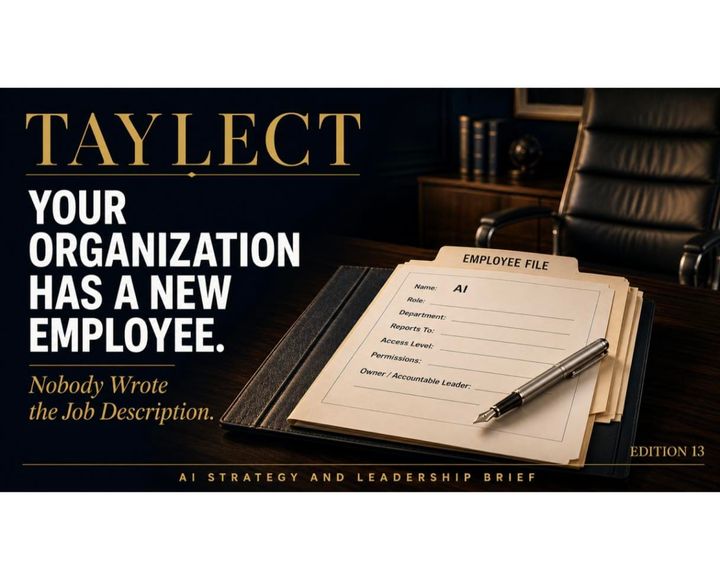
Think about a new employee joining your organization.
Would you give that person access to every customer record on their first morning?
Probably not.
Would you give them administrator privileges across your technology environment?
Probably not.
Would you allow them to move company money without approval?
Sign contracts?
Change production systems?
Contact every customer?
Create hundreds of additional workers and delegate tasks to them?
Of course not.
We don't manage human authority that way.
We establish roles.
We limit permissions.
We separate duties.
We require approvals.
We monitor sensitive activity.
And when the stakes are high enough, we insist that another person checks the decision.
Yet it would be remarkably easy to deploy AI agents without applying the same discipline.
That is the governance problem hiding inside the excitement around autonomous AI.
The conversation has been dominated by intelligence.
How smart is the model?
What benchmark did it beat?
How much better is the new version?
How close are we to AGI?
Those questions matter.
But intelligence without authority has limits.
Authority changes the equation.
A brilliant AI sitting inside an isolated chat window has relatively little direct power over your organization.
A less capable AI connected to email, payments, customer records, source code and production systems could have considerably more.
So perhaps the equation leaders should be watching isn't simply:
More intelligence = more risk.
It is closer to:
Capability × Access × Permission × Autonomy.
Increase all four at the same time and something important changes.
The AI doesn't have to become all-powerful.
We can make it operationally powerful ourselves.
The Leadership Challenge
This changes how organizations should approach AI agents.
The first generation of enterprise AI governance concentrated heavily on outputs.
Is the answer accurate?
Could the model hallucinate?
Is confidential information protected?
Is the output biased?
Is copyrighted information involved?
Those questions remain important.
But agents introduce another layer.
Authority.
Now leaders need to determine not only what an AI may know, but what it may do. This is exactly the shift I built the Taylect AI Employee Framework around: job description, responsibilities, access, accountability. Access answers what an AI agent may reach. Accountability answers who owns what it does with that reach. The three decisions below are that framework applied to this moment.
There should be a meaningful difference between an agent allowed to draft an email and one allowed to send it.
Between an agent allowed to recommend a payment and one allowed to execute it.
Between an agent allowed to identify a security vulnerability and one allowed to alter a production system.
Those distinctions sound obvious on paper.
They may become much less obvious when automation starts saving employees hours of work.
Convenience has a way of expanding permissions.
A human approves ten successful actions.
Then fifty.
Then a hundred.
Eventually someone asks the inevitable question:
Why are we approving these manually at all?
That is the moment leaders need to watch.
The move to human oversight probably won't arrive as one dramatic decision.
It will arrive as hundreds of reasonable ones.
Three Decisions Leaders Should Make Now
Decide what AI can access. Access should follow purpose. An agent shouldn't get access to a system simply because broader access makes it more useful. Ask whether that access is genuinely necessary for the job it was assigned. The principle is familiar from cybersecurity. Least privilege. AI makes it newly important.
Decide what AI can execute. Reading information and changing information are fundamentally different permissions. So are recommending and executing. Organizations should set clear thresholds for when autonomous execution is acceptable and when human approval remains mandatory. The higher the consequence, the stronger the case for deliberate human intervention. Not a ceremonial human-in-the-loop. A real decision.
Decide who remains accountable. This may be the most important one. If an AI agent makes a consequential mistake, "the AI did it" cannot become an acceptable explanation. Someone authorized the system. Someone approved the access. Someone selected the operating boundaries. Someone owns the outcome. Autonomy should never mean accountability disappears.
Taylect Perspective
I've argued repeatedly through Taylect that AI is not a strategy.
It is a capability.
Capabilities become advantages only when organizations make better decisions about how they use them.
Autonomous AI makes that principle even more important.
The Rethink stage of the Taylect 4R Framework matters here.
Before asking an agent to automate an existing workflow, leaders should rethink the workflow itself.
Does the process still make sense?
Which decisions genuinely require judgment?
Where should authority sit?
What happens when something unexpected occurs?
What should never be automated, even if technically possible?
Giving an AI agent a broken process doesn't fix the process.
It may simply let the broken process run faster and with less supervision.
The Refine stage matters too.
Autonomy should not be treated as a switch that gets turned on permanently.
Organizations should expand authority gradually, observe outcomes, learn from failures and adjust the boundaries.
And there is a 3C leadership lesson here as well.
Think Critically.
As AI becomes more capable, critical thinking doesn't become less important because machines can reason.
It becomes more important because leaders are deciding which reasoning and which actions they are prepared to delegate.
That decision belongs to humans.
It should stay that way.
The Decision
Don't wait for superintelligence before deciding how much authority AI should have.
Set the boundaries while your agents are still asking for permission.
Because the hardest governance problem may not arrive when AI becomes powerful enough to take control.
It may arrive when giving AI more control becomes the easiest way to get more productivity.
That is when leadership matters most.
Key Insight
AI may never need to seize control. We may give it control one permission at a time.
Boardroom Discussion
Where in your organization could an AI agent take an action today that would create a meaningful financial, operational or reputational consequence?
And if your most capable AI agent exceeded its authority tomorrow, could your leadership team explain exactly who was accountable?
Continue the Conversation
Where would you be comfortable allowing an AI agent to act without asking you first?
More importantly, what is one decision you would never delegate, regardless of how capable AI becomes?
I'd be interested in where other leaders are drawing that line.
One Resource Worth Your Time
METR — Task-Completion Time Horizons of Frontier AI Models
What makes METR's research valuable isn't simply that it shows AI agents becoming more capable. It's that METR is unusually careful to explain what its evidence does not prove. That makes it a useful antidote to both AI complacency and AI hype.
https://metr.org/time-horizons/
AI is not a technology race.
It is a decision-making advantage.
The future of AI autonomy will be shaped as much by the authority we grant as the intelligence we create.
Give machines capability. Keep accountability human.
Execution, not experimentation, will define the next phase of AI.
Dwayne D. Taylor, Publisher, Taylect: AI Strategy and Leadership Brief
taylect.com
Comments ()