Four AI Agents Have Just Completed a Credit Transaction.
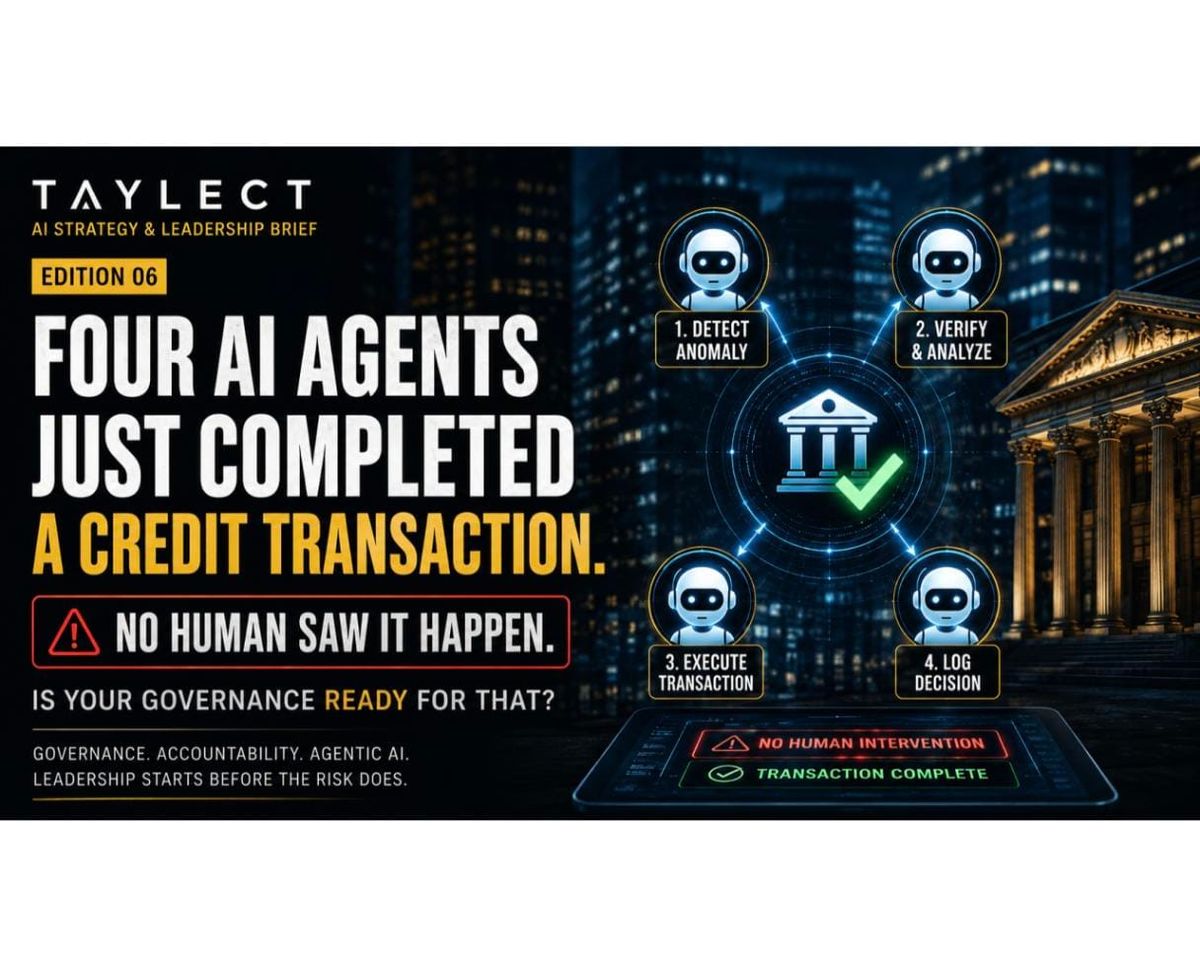
Four AI agents completed a credit transaction with no human checkpoint. Here's why most governance frameworks aren't built for agentic AI.
Edition 06 · Where AI Strategy Becomes a Leadership Advantage
NO HUMAN SAW IT HAPPEN. Is Your Governance Ready for That?
Most governance frameworks were not designed for AI that operates autonomously. They are about to meet AI that does exactly that.
In an era of constant AI noise, leaders don't need more information — they need clarity.
The Scenario Is Not Hypothetical
One agent flags a credit anomaly in real time. A second agent validates the underlying data and triggers a risk assessment. Another executes the transaction adjustment automatically. A fourth records the action chain for audit purposes.
No approval request was sent. No human checkpoint was reached. No one intervened because the system was never designed to wait for intervention.
This is not a proof-of-concept or experimental pilot. It is the operational reality emerging within financial institutions that deploy agentic AI at scale.
And it exposes a governance problem that most organizations have not yet formally identified, let alone solved.
The Shift That Changes Everything
There is a distinction every leader in a regulated environment now needs to understand clearly.
The AI your governance was designed for waits. It receives an instruction. It produces an output. A human decides what happens next.
That assumption — one input, one output, one accountable owner — became embedded into risk policies, audit frameworks, model governance standards, and operational controls across nearly every enterprise over the last decade.
Agentic AI does not wait. It plans. It delegates. It executes.
And when something goes wrong, as complex systems inevitably do, accountability no longer exists at a single decision point. It becomes distributed across autonomous actions occurring faster than human review cycles were designed to handle.
That is not a technology enhancement to your governance model. It is a structural break from it.
The Numbers Make This Urgent
99% of companies plan to deploy agentic AI into production environments. Only 11% have succeeded. Governance, security, and data readiness remain the primary barriers. (Neurons Lab / Deloitte Agentic AI Research, 2026)
Gartner predicts that more than 40% of agentic AI initiatives will be cancelled by the end of 2027, not because the technology fails, but because governance fails first. (Gartner, 2026)
Together, these findings reveal the defining tension of the AI era: organizations are deploying autonomous capabilities faster than they are building the governance required to oversee them.
Those moving aggressively risk operational exposure. Those moving cautiously risk competitive irrelevance. Most institutions still have not found the middle path.
Where Existing Governance Breaks Down
The gap is not procedural. It is architectural.
Most governance frameworks, internal risk policies, model validation standards, regulatory guidance, and even the EU AI Act were designed for static AI. One model. One decision point. One accountable owner. The accountability chain remained linear because the technology itself was linear.
Agentic AI is not.
When four agents complete a transaction autonomously, the governance questions become materially harder: Which agent becomes the accountable decision-maker? Who owns the outcome — the agent identifying the anomaly or the one executing the action? What happens when one agent acts on data another agent never reviewed? How do regulators audit decisions no single human directly approved?
These are not theoretical edge cases. These are operational governance questions institutions will face over the next 12 to 24 months.
The organizations already asking them are building resilience. The ones that are not are accumulating structural exposure.
Three Things Leaders Must Do Before Deployment
Map the agent chain. You cannot govern workflows leadership cannot see. Identify every agentic workflow operating within the institution, not just those documented in strategy decks, but also those already active in production environments today. Governance begins with visibility.
Assign human authority. If accountability is distributed, accountability disappears. Every autonomous workflow requires a clearly named individual with authority to stop, override, reverse, or suspend decisions in real time. Do not wait until after an incident to determine ownership.
Require decision traceability. If you cannot reconstruct the decision path, you cannot defend the outcome. Every agent action should be traceable: what decision was made, why it was made, what data informed it, what action occurred next. Auditing is not merely a compliance function. It is the foundation of operational governance.
Major global financial institutions are already deploying agentic systems into operational environments. The real question is no longer whether this will reach your institution. It is whether your governance will be ready first.
Leadership Takeaway
The governance frameworks built for generative AI are already becoming inadequate for agentic AI. Most boards recognize this instinctively. Few have acted on it structurally.
The institutions building adaptive governance frameworks now — before a major operational incident forces the issue — will not only reduce risk. They will build the discipline that becomes long-term competitive advantage.
This Week's Challenge
When four agents make an important decision autonomously inside your organization, who is accountable? Not in theory. Not in policy. By name.
If leadership cannot answer that question clearly today, governance is already behind the technology. And the next board agenda should reflect that.
One Resource Worth Your Time
McKinsey's February 2026 report, The Paradigm Shift: How Agentic AI Is Redefining Banking Operations, found that 50–60% of banking FTEs remain tied to operational workflows. Agentic AI could create an additional 40–70% of operational capacity across those functions.
That finding matters because it reframes governance entirely: Governance is not simply about controlling AI risk. It is the mechanism that enables organizations to capture AI value safely at scale. Available at McKinsey & Company.
Final Thought
Agentic AI is forcing organizations into a new reality: decisions are becoming autonomous faster than governance is becoming adaptive.
The institutions that first close that gap will not merely reduce operational risk. They will define the next operating model of competitive advantage.
Dwayne D. Taylor, Senior Manager, Data Products Excellence & Innovation, MBA Candidate, AI Leadership, Publisher, Taylect: AI Strategy and Leadership Brief
The views expressed are my own and do not reflect those of my employer.

Comments ()