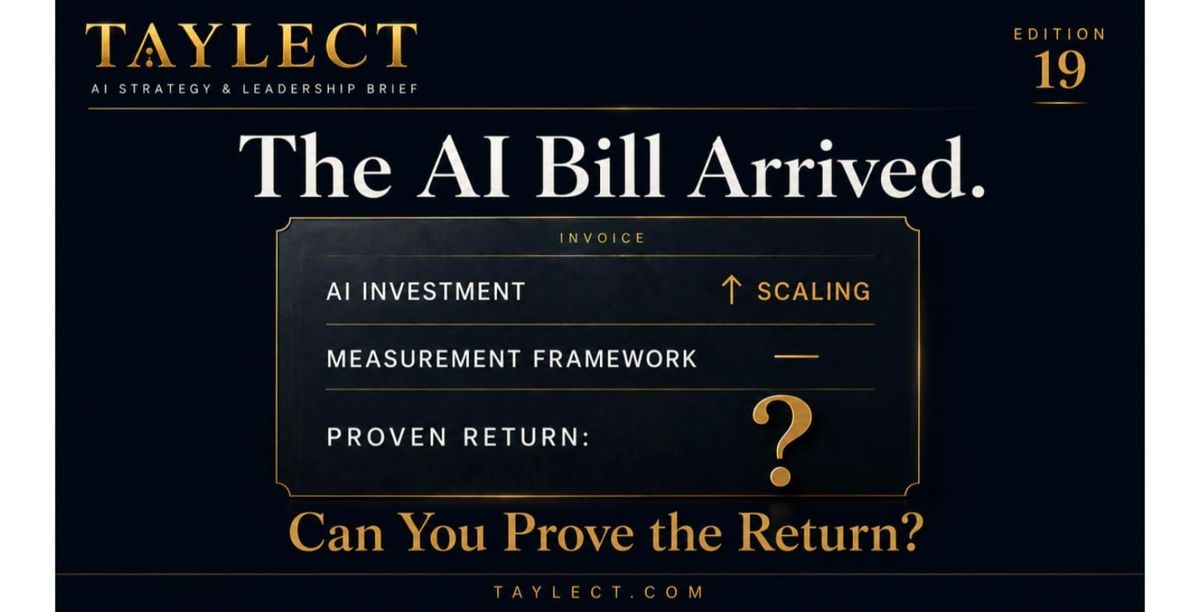
The AI Bill Arrived. Can You Prove the Return?
As AI spending scales across the enterprise, most organizations still measure usage rather than value. Taylect argues that AI cost management should shift from minimizing spend to identifying which workflows justify spending more, and building the governance to answer that question with evidence.
Edition 19 · Where AI Strategy Becomes a Leadership Advantage
AI usage is scaling faster than many organizations can measure its value. The next leadership challenge is knowing what each AI investment actually produces.
Executive Brief
The Signal: AI is changing the economics of enterprise software. Traditional software gave leaders a relatively predictable unit of management licenses, seats, infrastructure, or subscriptions. AI is different. Its cost can vary with the selected model, the amount of context processed, the output generated, the reasoning required, the tools invoked, caching, and, particularly with AI agents, the number of times a system loops through a task before completing it. That means organizations can increase AI consumption much faster than they increase business value.
Why It Matters: The wrong response is to obsess over token prices or suppress AI usage. The better question is: what did the AI produce, what did that outcome cost, and was it worth it? BCG argues that AI economics increasingly need to be managed at the workflow level, with costs tied to completed outcomes rather than to activity alone. That changes AI measurement from a technology metric into a leadership discipline.
The Leadership Decision: Do not scale a significant AI deployment until the organization can define the business outcome it is expected to improve and how that outcome will be measured. The organizations creating durable AI value will not necessarily have the smallest AI bills. They will know where spending more creates more value and where it does not.
Strategic Analysis
Here is a conversation I keep finding myself in.
A business unit deploys an AI tool. Usage climbs. Employees like it. More workflows are automated. Then someone asks a deceptively simple question.
What did we get for the money?
The room becomes much less certain.
Not necessarily because the AI failed. Because many organizations still define AI success by activity: users, prompts, tokens, licenses, generated code, automated tasks, or estimated hours saved.
Those numbers tell leaders whether AI is being used.
They do not necessarily tell them whether AI is creating value.
That distinction is becoming more important as AI moves from experimentation into operating budgets.
PwC's 2026 Global CEO Survey, based on 4,454 CEOs across 95 countries and territories, found that only 12% reported AI delivering both increased revenue and lower costs. Thirty-three percent reported a benefit in either revenue or cost, while 56% reported neither significant financial benefit.
The finding does not prove that poor measurement is causing weak returns.
It does reveal something more important.
AI adoption and AI value are not the same thing. And leaders increasingly need a management system capable of distinguishing between them.
AI Is Changing the Unit of Management
For most leaders, understanding every technical detail of how AI processes information is unnecessary.
Understanding the economic significance is not.
AI models work by breaking language into small units before processing and generating responses. When organizations use AI services directly through APIs, consumption of these units becomes one component of the cost of delivering that intelligence.
But there is no universal price.
Costs vary significantly by model, provider, context size, caching, service tier, and workload. Premium frontier models can cost several dollars per million input units and considerably more per output unit, while smaller and faster models can cost a fraction of that.
And many organizations do not buy AI on this basis at all. They may pay through subscriptions, enterprise licenses, committed capacity, credits, hybrid contracts, or usage-based arrangements.
That makes the leadership problem more complicated, not less.
Traditional enterprise software was comparatively easy to understand.
How many licenses do we have? How many people use them? What does each seat cost?
AI introduces a different set of questions.
Which model completed the task? How much context did it process? How much reasoning was required? Did the system invoke other tools? Did an agent complete the task in three steps or thirty? Could a less expensive model have produced an acceptable result?
And, most importantly, what business outcome did all of that intelligence create?
BCG describes this as a change in the unit of management. That is one of the most important shifts in enterprise AI economics.
The Uber Warning
Uber offers a useful illustration of how quickly the economics can change.
In 2026, Uber's CTO said that the rapidly expanding use of AI coding tools had already exhausted the company's planned full-year budget for those tools, only months into the year.
That does not mean Uber's AI investment failed.
It demonstrates how quickly successful adoption can create a new management problem.
Uber's President and COO later described another challenge connecting dramatic increases in AI-generated code and usage to a proportional increase in consumer-facing projects actually being shipped.
Again, that does not establish that AI created no value.
It reveals the measurement gap.
Usage can be visible long before business impact is.
That distinction matters because organizations are about to encounter the same problem across far more than software development. Customer service agents. Research systems. Sales assistants. Financial analysis. Marketing workflows. Knowledge management. Document processing. Operations. Product development.
As AI agents become capable of executing longer sequences of work, the number of actions taken may rise dramatically. But an organization does not create value because an agent took 40 steps. It creates value because the agent accomplished something worth more than the resources required to accomplish it.
The Wrong Metric Can Create the Wrong Behaviour
This is where AI cost management can go wrong.
Imagine a CFO sees a rapidly growing AI bill and establishes a simple mandate: reduce AI consumption by 20%.
That sounds disciplined.
It may not be.
The organization could reduce its AI bill while simultaneously eliminating its highest-return AI workflows.
A customer-service workflow costing $3 to resolve an issue that previously cost $12 is not expensive because it is heavily consumed. It is valuable because the economics of the completed outcome are attractive.
Conversely, a workflow consuming very little may still be wasteful if it produces nothing useful.
That is why the relevant question is not: how much AI are we consuming?
It is: what does a successful outcome cost?
BCG argues that organizations should increasingly evaluate AI at the workflow level using measures such as cost per resolved ticket, completed analyses, successful customer interactions, or other meaningful business outcomes.
That creates a very different management philosophy.
The goal is not to minimize AI spending. The goal is to become confident enough to spend more where AI works and disciplined enough to stop spending where it does not.
That is capital allocation. Not cost cutting.
The AI Budget Is Becoming a Leadership Issue
Deloitte's research illustrates how significant the investment has already become.
More than half of executives surveyed said AI automation accounted for between 21% and 50% of their digital initiative budgets, with an average allocation of 36%.
Deloitte also found that many organizations report returns from their AI investments. That is important because the AI-value story is not simply one of failure. The more complicated reality is that value is emerging unevenly, across different use cases and through different measures.
PwC found something similar. Only 12% of CEOs reported both revenue increases and cost reductions from AI — but organizations with stronger AI foundations were substantially more likely to report meaningful financial returns.
The leadership question, therefore, should not be: "Is AI delivering ROI?"
That question is too broad.
A better question is: which AI workflows are producing measurable value, which are not, and what distinguishes them?
That is a question leaders can actually manage.
Governance as Competitive Advantage
This is where AI economics becomes more than a finance issue.
The decisions that determine AI costs are distributed across the organization. Technology teams choose models. Product teams design workflows. Employees determine how tools are used. Finance allocates budgets. Procurement negotiates contracts. Risk teams establish boundaries. AI agents may increasingly make decisions about which tools to invoke and how many steps to take.
No single department controls the economics.
That makes AI cost discipline a governance capability.
Organizations need visibility into questions such as which workloads genuinely require frontier models, which can be routed to smaller, less expensive alternatives, when context should be cached rather than repeatedly processed, which agent workflows should have spending or execution limits, who owns the business outcome being measured, what level of performance justifies additional AI consumption, and when an AI workflow should be redesigned or stopped.
BCG argues that CFOs and CIOs need workflow-level visibility that shows what is happening, shapes costs, and proves value.
That creates a new governance principle.
Every material AI workflow needs both a technical owner and an economic owner. Someone must understand how the system works. Someone must be accountable for whether the result is worth the cost.
Ideally, those responsibilities are met before deployment, not after the invoice arrives.
This Is Not Just an Enterprise Problem
The numbers may be smaller for a small business.
The decision is identical.
Imagine a 20-person professional-services firm spending $500 a month across AI subscriptions and usage. The useful question is not whether employees are using AI enough. It is whether that $500 reduced the time required to prepare client work, increased the number of customers the team could serve, reduced outsourced work, shortened sales cycles, improved response times, or recovered enough employee capacity to justify the expenditure.
A small business has an advantage here. It often has fewer systems, shorter decision chains, and clearer visibility into the relationship between an investment and its outcome.
The principle scales down remarkably well.
Do not measure AI by how much people use it. Measure it by what changed because they used it.
Taylect Perspective
The measurement problem is not fundamentally a cost problem.
It is the adoption-without-understanding gap, expressed in economic terms.
Organizations spent the first phase of generative AI asking: where can we use AI?
The next phase requires a harder question: where does using AI create enough value to justify scaling it?
That distinction connects directly to the Taylect 4R Framework.
Rethink before you Replicate. Before introducing AI into a workflow, challenge the workflow itself. What problem are we solving? What outcome matters? What would success look like? What would that outcome be worth? Only then should an organization decide how AI should reproduce or improve the work.
The measurement conversation also strengthens the Refine stage. Once deployed, the workflow should continuously be evaluated against the outcome it was designed to produce. Did cost fall? Did revenue increase? Did cycle time improve? Did quality improve? Did employees recover meaningful capacity? Did the economics deteriorate as usage scaled?
Rethink defines the value before deployment.
Refine tests whether the value appeared afterward.
Without those two disciplines, organizations risk scaling AI activity instead of AI value.
The Opportunity Most Leaders Should Not Miss
There is a danger that rising concern about AI costs produces the wrong executive response.
Organizations may conclude that good AI governance means consuming less AI.
It does not.
Good governance means knowing where additional AI consumption produces additional value.
Consider two workflows. One costs $100,000 annually and produces $500,000 in measurable economic benefit. Another costs $20,000 and produces little evidence of meaningful improvement. The second workflow has the smaller AI bill. It is also the worst investment.
That distinction matters because the next competitive advantage may not belong to the organization with the lowest AI costs. It may belong to the organization with the confidence to invest aggressively in AI because it understands its unit economics better than competitors do.
Measurement therefore does more than control spending.
It permits leaders to scale what works.
Three Questions Every Leader Should Answer
What outcomes are our significant AI deployments expected to improve? Not usage. Not prompts. Not tokens. Business outcomes.
What does each successful outcome cost? For customer service, that might be cost per resolved issue. For software development, cost per completed feature or cycle-time improvement. For sales, cost per qualified opportunity or incremental revenue. For knowledge work, it may involve validated time recovered, improved throughput, quality, or decision speed. The measure should fit the workflow.
Who is accountable for proving that the economics still make sense as usage scales? AI costs can change. Models change. Prices change. Workflows change. Agent behaviour changes. A deployment that made economic sense six months ago should not automatically receive permanent approval. Someone must own the outcome.
The Decision
AI is changing the unit of management.
For traditional software, leaders could often manage access. For AI, they increasingly have to manage outcomes.
That requires a different discipline.
Do not ask only, "How much AI are we using?"
Ask: what did it accomplish? What did that outcome cost? What was the outcome worth?
And then make the decision that follows.
Spend more. Redesign the workflow. Choose a different model. Or stop.
The organizations that develop this capability will have something more valuable than a lower AI bill.
They will know where AI deserves the next dollar.
Key Insight
The goal of AI cost management is not to spend less. It is to know where spending more creates value.
Boardroom Discussion
Ask your leadership team to select the organization's five largest or most strategically important AI deployments.
For each one, answer three questions. What business outcome is this system expected to improve? What does a successful outcome cost? What evidence tells us the return justifies further investment?
If the answers require weeks of reconstruction, that is itself useful information. The organization has built AI infrastructure faster than it has built AI measurement infrastructure. And that gap becomes more consequential as AI scales.
Drop your answer in the comments. I read every one.
If this changes how your organization thinks about AI investment — share it with one CFO or finance leader who has seen the AI bill arrive without a clear return attached to it.
Every week, one sharp analysis of AI strategy, governance, and leadership. Written from the practitioner's perspective. No hype. Just clarity.
Continue the Conversation
The AI measurement conversation is one most organizations have been avoiding — because answering it honestly requires admitting that not every deployment has a clear return.
Which AI workflow in your organization would you most struggle to justify to your board right now — and what would it take to answer that question confidently?
One Resource Worth Your Time
BCG's July 2026 analysis "Return on AI: What CEOs Need to Know About the True Cost of Artificial Intelligence" provides one of the clearest executive treatments of the emerging economics of AI consumption. Its most important contribution is not its discussion of costs. The argument is that organizations need to shift from managing AI activity to managing AI at the workflow and outcome levels. For CEOs, CFOs, and CIOs, determining how AI should move from experimentation to operating discipline is the conversation worth having. Available at bcg.com.
AI is not a technology race. It is a decision-making advantage.
The organizations that succeed will not necessarily be the ones that spend the most on AI. Nor will they be the ones that spend the least. They will be the ones that know where AI creates enough value to justify spending more.
Execution, not experimentation, will define the next phase of AI.
Dwayne D. Taylor
Publisher, Taylect: AI Strategy and Leadership Brief, taylect.com
The views expressed are my own and do not reflect those of my employer.