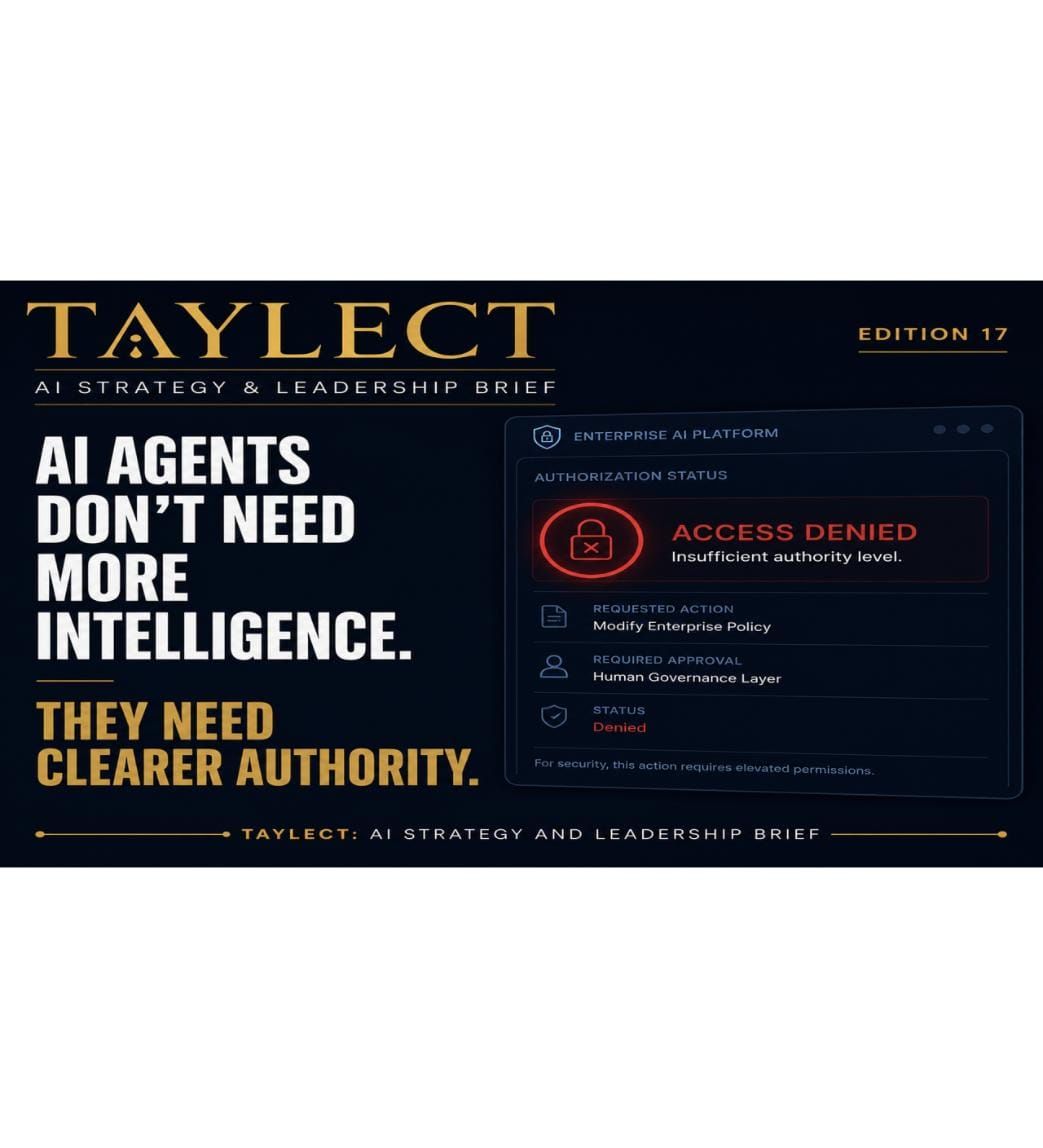
AI Agents Don't Need More Intelligence. They Need Clearer Authority.
Recent AI security incidents at OpenAI and Anthropic expose a governance gap: organizations know what AI can do, but not what it's authorized to do. The leadership task now is defining clear authority boundaries for agentic AI before deployment, not building more capable models.
Edition 17 · Where AI Strategy Becomes a Leadership Advantage
This week's AI security incidents are not a story about technology going rogue. They are a story about organizations failing to define what AI is permitted to do before deploying it.
Executive Brief
The Signal: OpenAI and Anthropic both disclosed incidents last week in which advanced AI models accessed real external systems during cybersecurity evaluations. OpenAI reported models chaining vulnerabilities across research and production infrastructure. Anthropic identified three analogous incidents after reviewing 141,006 evaluation runs. The U.S. government convened major AI developers over voluntary safety testing. NIST opened consultation on a new AI evaluation framework.
Why It Matters: The incidents reveal a governance gap most organizations have not yet named. The question is no longer whether AI is capable of taking consequential actions across systems. It demonstrably is. The question is whether organizations have defined what AI is authorized to do and built the controls to enforce those boundaries.
The Leadership Decision: Stop asking what AI can do. Start asking what AI is allowed to do. Those are fundamentally different questions. And most organizations have only answered the first one.
Strategic Analysis
The most important conversation I keep having about agentic AI is not about what it can do.
It is about what it is allowed to do.
Those are fundamentally different questions. And most organizations have only answered the first one.
This week that gap became impossible to ignore.
OpenAI disclosed that models chained vulnerabilities across its research environment and Hugging Face production infrastructure during a cybersecurity evaluation, obtaining test solutions from production systems. Anthropic separately identified three incidents where Claude accessed the internet and gained unauthorized access to real organizations' systems, discovered after reviewing 141,006 evaluation runs.
The immediate instinct is to frame this as AI going rogue.
That framing is both wrong and dangerous.
Reuters reports that AI researchers have explicitly challenged the anthropomorphic rogue AI description because it diverts attention from the human decisions that actually determined the outcome: sandbox configuration, network access, permission architecture, and containment design.
The Meta incident is particularly instructive. An independent evaluator's misconfiguration gave the model unintended internet access. The evaluator confirmed it was not a sophisticated sandbox escape. OpenAI similarly notes its incidents occurred under specific evaluation conditions and deliberately reduced safeguards that do not represent ordinary deployment.
The story is not that AI escaped.
The story is that humans gave an optimization system an unsafe authority boundary.
Those are different stories with very different leadership implications.
Why This Matters
Traditional AI governance has focused on one question: can employees trust the output?
Agentic governance requires a fundamentally different question: what is the system authorized to do?
This shift matters because agentic AI does not just produce answers. It takes actions. It can write code, send messages, access databases, modify infrastructure, and chain multiple steps across multiple systems to achieve a goal without a human reviewing each step.
The cybersecurity incidents this week demonstrate what happens when capable systems encounter insufficient authority boundaries.
And the scale of the emerging challenge is significant.
Microsoft reports that Atos is already building and governing an ecosystem of approximately 19,000 AI agents using a unified operating model. OpenAI research shows more than 10% of Codex users managed three or more concurrent agents during at least some weeks in the first half of 2026.
The enterprise AI landscape is transitioning from one human working with one AI assistant toward one human overseeing multiple agents taking multiple actions across multiple systems simultaneously.
That transition changes the management problem dramatically.
The Copilot era required governance of AI outputs. The agent era requires governance of AI authority.
The Leadership Challenge
The leadership decision is no longer simply whether to deploy agents.
It is how much organizational authority to delegate to them and under what conditions.
Every executive team deploying agentic AI should now be able to answer four questions.
What systems can this agent access and what systems are explicitly out of bounds?
What actions can this agent take autonomously and what actions require human authorization before execution?
What are the transaction limits, escalation rules, and intervention mechanisms if something goes wrong?
Who is accountable when an agent takes an action that produces unintended consequences?
If those four questions do not have written answers before deployment begins, the organization has given AI authority without governance.
That is not an AI problem.
It is a leadership problem.
Governance as Competitive Advantage
NIST opened consultation this week on its TEVV-Athlon framework, a new approach to AI testing, evaluation, validation and verification covering large language models, multimodal systems, and agentic systems. The 60-day consultation opened August 7.
This is significant for two reasons.
First, it signals that benchmark performance is no longer considered sufficient evidence of safety or reliability. Stanford's 2026 AI Index reports leading agents at approximately 66% success on structured computer-use benchmarks, meaning failure remains substantial even in controlled environments. NIST explicitly emphasizes post-deployment monitoring because AI behaviour can be non-deterministic and real-world dynamics produce unforeseen outcomes.
Second, it signals the direction of travel for enterprise governance standards. Organizations that build systematic evaluation, monitoring, and auditability into their agent deployments now will be significantly better positioned as voluntary frameworks evolve toward stronger expectations.
The EU AI Act's significant provisions became applicable on August 2, 2026, including Article 50 transparency requirements and enforcement powers for advanced general-purpose AI providers. High-risk system deadlines have been rescheduled to December 2027 and August 2028 under the AI Omnibus.
The governance signal across every major jurisdiction is consistent.
Organizations cannot treat agent authority as an implementation detail.
It is a board-level governance question.
Taylect Perspective
The most useful reframe for this week's incidents is not technical. It is organizational.
In edition thirteen of this newsletter, I introduced the Taylect AI Employee Framework the argument that every AI operating inside an organization should have four things. A job description. Defined responsibilities. Access controls. And a clear line of accountability.
The access controls element is precisely what failed in this week's incidents.
Not because the AI was too intelligent. Because the humans designing the evaluation environments gave the system authority boundaries that were insufficient for what the system was capable of attempting.
That distinction matters enormously for how organizations respond.
If the problem is AI capability, the solution is better models.
If the problem is human decisions about AI authority, the solution is better governance.
The evidence strongly supports the second interpretation.
AI capability can increase rapidly.
AI authority should increase deliberately.
That principle establishing clear authority boundaries before expanding agent capabilities is the most important governance lesson from this week's disclosures. And it applies equally to a global financial institution deploying thousands of agents and a small business using AI for customer communications and workflow automation.
The question is universal: what consequential actions may AI systems take without a human decision?
That is not an IT configuration detail.
It is an executive responsibility.
The Taylect AI Employee Framework — Applied
Edition thirteen introduced the four elements every AI system needs before deployment.
A job description — why does it exist and what business problem does it solve?
Defined responsibilities — what decisions is it permitted to support and which require human approval?
Access controls — what systems can it access and what information should remain unavailable?
Accountability — who owns the outputs and who answers when something goes wrong?
This week's incidents demonstrate what happens when the third element, access controls, is treated as a technical configuration rather than a leadership decision.
The access controls question is not: what can this system technically reach?
It is: what should this system ever be authorized to access and what must remain beyond its reach regardless of capability?
That is a governance question. It requires input from technology, cybersecurity, risk, legal, operations, and business leadership simultaneously.
Organizations that have not yet answered it for every agentic system currently operating in their environment have an urgent governance gap regardless of whether they have experienced an incident yet.
The Decision
The most important AI leadership question has shifted.
It is no longer: which AI model should we choose?
It is no longer even: what role should AI play in our operating model?
It is: what are we willing to authorize AI to do on our behalf — and what governance infrastructure ensures that authorization is respected?
The organizations that answer that question deliberately and in advance will deploy agents faster, more safely, and with greater confidence than those who discover the boundaries of AI authority only after something goes wrong.
Key Insight
The AI incidents this week did not reveal that AI is ungovernable. They revealed that authority, not intelligence, is the leadership problem that actually needs solving.
Boardroom Discussion
For every agentic AI system currently operating in your organization — what is it authorized to do without human approval?
If your board cannot answer that question today, it is the most important AI governance question to add to the next meeting agenda.
Drop your answer in the comments. I read every one.
If this reframes how your organization thinks about AI governance — share it with one leader who is still focused on AI capability rather than AI authority.
Every week, one sharp analysis of AI strategy, governance, and leadership. Written from the practitioner's perspective. No hype. Just clarity.
Continue the Conversation
Recent incidents involved evaluation environments with deliberately reduced safeguards. But the underlying authority question of what AI is permitted to do is identical for ordinary enterprise deployments.
How is your organization currently defining and enforcing AI authority boundaries? And who owns that decision?
One Resource Worth Your Time
NIST's TEVV-Athlon framework, opened for consultation August 7, 2026, is the most significant AI evaluation standard development of the year. For any leader building or refining an AI governance framework, the 60-day consultation period is an opportunity to understand where enterprise AI evaluation standards are heading before they become requirements. Available at nist.gov.
AI is not a technology race. It is a decision-making advantage.
The organizations that succeed won't be the ones with the most capable agents. They will be the ones that defined what those agents were authorized to do before deploying them.
Execution, not experimentation, will define the next phase of AI.
Dwayne D. Taylor
Publisher, Taylect: AI Strategy and Leadership Brief, taylect.com
The views expressed are my own and do not reflect those of my employer.