AI Strategy Has A New Control Point.
As open-weight AI models close the gap with closed frontier systems, the strategic question shifts from which model to choose to where control over AI should live. Leaders need a framework for deciding what to own, outsource, and keep under organizational control.
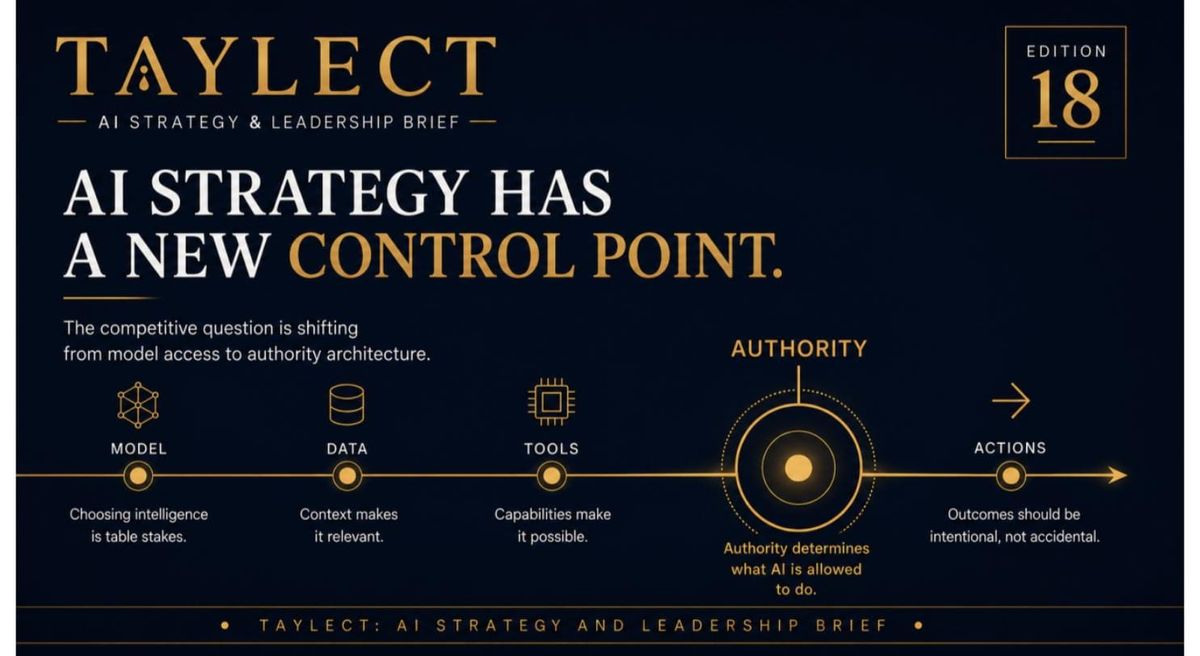
Edition 18 · Where AI Strategy Becomes a Leadership Advantage
The AI Decision Has Changed. Most Organizations Are Still Answering the Wrong Question.
As capable AI becomes cheaper and more widely available, the strategic question is no longer which model to choose. It is where control should live.
Executive Brief
The Signal: On August 10, Meta released Muse Glimmer, a 30-billion-parameter open-weight model that runs on a single consumer GPU, under a permissive Apache 2.0 license. By May 2026, Chinese open-weight models already accounted for roughly 61% of all tokens consumed on major AI platforms, with four of the five most-used models coming from Chinese labs. The open-weight frontier is no longer a fringe consideration. It is reshaping the enterprise AI landscape.
Why It Matters: As powerful AI becomes cheaper, more open, and easier to deploy, access to AI itself becomes less distinctive. The organizations that will generate durable competitive advantage are not the ones that chose the right model. They are the ones that answered a harder question first: where should control over our AI actually live?
The Leadership Decision: Stop asking which AI model is best. Start by asking what your organization should own, what it should outsource, and what it must remain able to control. Those are fundamentally different questions. And most organizations have only answered the first one.
Strategic Analysis
The question I keep hearing from leaders has changed.
A year ago it was which AI model should we use? Now it is something harder to answer.
For much of the generative AI era, enterprise AI strategy revolved around a familiar debate. OpenAI or Anthropic. Google or Microsoft. Something proprietary or something open. That debate made sense when access to capable AI was genuinely scarce, and the gap between frontier closed models and everything else was significant.
That gap is closing faster than most enterprise strategies anticipated.
On August 10, Meta released Muse Glimmer, a 30-billion-parameter model optimized for local, agentic workflows that runs on a Mac or PC with a single consumer graphics card under a permissive open-source license. Meta CEO Mark Zuckerberg used the launch to make a broader argument for open-weight AI, positioning openness as a way to reduce costs, increase customization, and prevent advanced AI from becoming concentrated in the hands of a small number of companies.
It would be easy to treat this as another model launch.
Leaders should not.
The context matters. By May 2026, Chinese open-weight models already accounted for roughly 61% of all tokens consumed on major AI platforms, with four of the five most-used models coming from Chinese labs. Meta's Llama, the prior open-weight leader, had fallen off the rankings entirely. Muse Glimmer is not just a product announcement. It is a strategic repositioning: Meta re-entering a competitive landscape dominated by Chinese open-weight releases for more than a year.
The more important signal for enterprise leaders is not which company released which model.
It is that open-weight AI is becoming capable enough and strategically important enough to change how organizations think about infrastructure, vendor dependence, cybersecurity, and governance.
Why This Matters
The first wave of enterprise generative AI offered a relatively simple operating model.
Organizations accessed powerful models through providers. The provider developed the model, operated the infrastructure, updated the system, and maintained significant control over how it could be accessed. That arrangement offered simplicity. But it also created dependence. Pricing could change. Models could be updated or retired. Access policies could shift. Organizations could find themselves dependent on infrastructure and capabilities they did not control.
The Anthropic shutdown in June, when a US government export-control directive forced Anthropic to suspend global access to its most advanced models for 19 days, made that dependence visible in a way most risk frameworks had never named.
Open-weight models alter the equation.
Their parameters can be downloaded and deployed on infrastructure selected by the organization. They can be adapted for particular purposes and operated privately without sending organizational data back to the original model provider. The UK's AI Security Institute identifies genuine benefits that open-weight models can be privately hosted, adapted to specific tasks, and operated without providers changing or deprecating the underlying model.
But greater control comes with a significant trade-off.
The organization may also inherit more responsibility.
The Leadership Challenge
The debate around open and closed AI is often framed too simply.
Open AI is presented as freedom, innovation, and competition. Closed AI is presented as a means of control, security, and corporate concentration. Neither description captures the full problem.
The same characteristics that give organizations greater control over an open-weight model can make those models harder to govern once deployed. A provider of a closed system can monitor access, modify safeguards, respond to emerging vulnerabilities, and restrict users. Once model weights have been widely distributed, many of those options disappear.
That creates an important paradox for leaders.
Greater organizational control can mean less ecosystem control.
The capability gap reinforces this. In July, the UK AI Security Institute reported that leading open-weight models performed similarly on its cyber evaluations to closed models released roughly four to seven months earlier. The frontier is moving too quickly for organizations to design long-term governance around the assumption that today's capability gap will remain stable.
The question, therefore, cannot simply be: is this model safe enough today?
Leaders also need to ask — what happens when this class of model becomes significantly more capable?
Governance as Competitive Advantage
Many organizations understandably want standardization.
Select an approved platform. Negotiate the contract. Establish governance. Train employees. Scale adoption.
But AI may not settle into the same architecture as previous generations of enterprise software. Different workloads may require fundamentally different control models. Highly sensitive internal knowledge may justify the use of privately operated models. Managed frontier platforms may better serve general productivity tasks. Customer-facing applications may require stronger monitoring and contractual accountability. Regulated processes may demand completely different oversight.
The strategic mistake would be turning a useful procurement decision into a permanent architectural assumption.
Five questions should anchor every organization's AI control conversation.
Who controls the model? Can the organization determine where it runs, how it changes, and what data reaches it?
Who controls the safeguards and protections enforced by the provider, the organization, or both?
Who can observe its behaviour? Can activity be logged, monitored, and investigated?
Who can stop it if a vulnerability or unexpected behaviour appears, and can access be restricted quickly?
Who is accountable when something goes wrong? Does responsibility sit with the developer, the deployer, a business function, or some combination?
These questions move AI strategy beyond model performance. They turn it into operating-model design.
Taylect Perspective
Access to capable AI is becoming easier.
If increasingly capable models can be obtained from multiple providers or downloaded, adapted, and operated privately, then access to AI itself becomes less distinctive.
That changes where competitive advantage is likely to come from.
The organizations that will generate durable value from AI are not the ones that chose the right model. They are the ones that understood which workloads genuinely required organizational control, which were better served through managed platforms, and what the consequences of dependency would be if access changed.
This is also not a binary decision. Control without capability is not necessarily an advantage. A smaller organization may gain little from owning more of the technology if doing so also means inheriting risks it cannot manage. Sometimes greater ownership is more responsibility.
The goal is not independence from AI providers. Nor is it maximum ownership. It is strategic optionality: the ability to adapt as the landscape shifts rather than being locked into architectural decisions made under different assumptions.
This connects directly to what Taylect has been arguing since edition thirteen. The question is not what AI can do. It is what AI is allowed to do and who retains the authority to answer that question. An organization that cannot answer the five control questions above has not built an AI strategy. It has built an AI dependency.
The Taylect 4R Framework — Applied
The open-versus-closed debate is exactly where the 4R Framework earns its place.
Rethink — before selecting a model or an architecture, interrogate the workload. Not which AI tool should we use, but why does this process exist and what does organizational control over it actually require? Different workloads have different answers.
Replicate — once the right control model for a workload is established, scale it consistently. The danger is replicating an AI architecture across all workloads simply because it is cheaper or already contracted — without asking whether that architecture is appropriate for each use case.
Reveal — the process of mapping AI control across an organization's workloads will surface dependencies, gaps, and concentrations that most risk frameworks have never named. The Anthropic shutdown revealed them at an industry level. An honest internal audit will reveal them at an organizational level.
Refine — as the open-weight frontier advances and the capability gap narrows, governance must evolve. The control model that is appropriate today may not be appropriate when the same class of model becomes significantly more capable. Build the discipline to revisit these decisions on a regular cadence — not only when a disruption forces the conversation.
The danger is in Replicate replacing one model with another because it is cheaper, without first asking whether the organization's underlying approach to control and governance should change.
Model economics matter. Organizational capability matters more.
The Decision
The AI industry will continue debating whether the future should be open or closed.
Executives have a different responsibility.
They need to decide where control creates business value and where owning that control creates unnecessary risk.
Almost everyone will soon have access to capable AI.
The harder question will be who has built the judgment, governance, and organizational capability to decide what that intelligence should be allowed to do.
The next competitive advantage in AI may not come from owning the smartest model.
It may come from knowing exactly where control should live.
Key Insight
Access to AI is becoming a commodity. The organizations that succeed will not be the ones with the best model. They will be the ones that built the governance to decide what their AI is permitted to do.
Boardroom Discussion
Your organization's AI architecture was almost certainly designed before open-weight models became strategically significant and before the Anthropic shutdown demonstrated what vendor dependency actually looks like in practice.
Does it need to be revisited?
Two questions worth bringing to your next leadership conversation.
Which AI workloads in your organization genuinely require organizational control, and which are better served by managed platforms?
If your primary AI vendor became unavailable or significantly changed its pricing or policies tomorrow, which business processes would stop, and do you have a plan for that?
Drop your answer in the comments. I read every one.
If this changes how your organization thinks about AI architecture, share it with one leader who is still treating model selection as a permanent strategic commitment rather than a portfolio decision.
Every week, one sharp analysis of AI strategy, governance, and leadership. Written from the practitioner's perspective. No hype. Just clarity.
Continue the Conversation
The open-versus-closed debate is often framed as ideological. But for enterprise leaders, it is an architecture decision with risk, cost, capability, and governance implications that differ by workload.
How is your organization currently thinking about AI portfolio design, and has the open-weight frontier changed any of those conversations?
One Resource Worth Your Time
The UK AI Security Institute's research on the risks and benefits of open-weight models is the most rigorous independent assessment currently available of the governance implications of open-weight AI deployment. For any leader making architectural decisions about whether to operate AI systems privately or through managed providers, this research provides the evidence base that most vendor conversations lack. Available at gov.uk/dsit.
AI is not a technology race. It is a decision-making advantage.
The organizations that succeed won't be the ones with the most capable models. They will be the ones who built the governance framework to decide where AI control should reside.
Execution, not experimentation, will define the next phase of AI.
Dwayne D. Taylor
Publisher, Taylect: AI Strategy and Leadership Brief, taylect.com
The views expressed are my own and do not reflect those of my employer.