The AI Honeymoon Is Over. What Comes Next Will Separate Adoption From Advantage.
Enterprise AI is moving from an experimentation phase into an accountability phase. Taylect argues that the next competitive advantage belongs to organizations that build the measurement, governance, and human capability needed to prove AI's business value, not just adopt it faster.

Edition 20 · Where AI Strategy Becomes a Leadership Advantage
The experimentation phase rewarded speed. The next phase will reward something harder: the organizational capability to turn AI activity into accountable business value.
Executive Brief
The Signal: Enterprise AI has reached an important transition. Organizations are deploying more AI. Large enterprises are scaling agents. Infrastructure investment continues to accelerate. Yet evidence of consistent enterprise-level financial returns remains uneven. PwC's 2026 Global CEO Survey found that only 12% of CEOs said AI had delivered both increased revenue and lower costs. HCLTech found that 90% of enterprise decision-makers said generative and agentic AI were transforming workflows, yet only 18% reported significant revenue impact. McKinsey added another signal this week: 40% of respondents from organizations with more than $1 billion in revenue said they are now scaling AI agents, up from 27% last year. Meanwhile, Nvidia expects roughly 70% revenue growth in its next fiscal year. These signals are not contradictory. They reveal the next leadership challenge. AI investment and capability are advancing faster than many organizations' ability to demonstrate enterprise value. The AI honeymoon is ending because experimentation is becoming accountability.
Why It Matters: The first phase of enterprise AI rewarded experimentation. Leaders needed to learn quickly. Pilots were useful. Adoption mattered. But experimentation and scale require different management systems. Once AI becomes embedded in workflows, receives access to enterprise systems, consumes significant budgets, or begins acting with greater autonomy, different questions become unavoidable. What did this investment produce? Which workflows should scale? What authority has been delegated to AI? Who is accountable? The post-honeymoon moment is not evidence that AI has failed. It is evidence that AI leadership is becoming more demanding.
The Leadership Decision: Leaders can continue managing AI primarily as an adoption challenge, adding tools, expanding access, launching agents and measuring activity. Or they can recognize that the next phase requires a different operating discipline. That means going back to rethink what AI was supposed to accomplish, then refine what has been built using evidence rather than enthusiasm. The organizations that create durable advantage will not necessarily be the ones that experimented fastest. They will be the ones that learn how to convert experimentation into organizational capability.
Strategic Analysis
Many leaders entered the AI era the way people enter a marriage.
With genuine optimism. Real commitment. And an assumption that enthusiasm would carry them further than it eventually could.
It rarely does.
But the honeymoon was not a mistake.
Organizations needed room to experiment. They needed to discover what AI could do before they could know where it genuinely belonged. Speed had value because learning had value.
The problem begins when organizations continue managing AI as though the honeymoon never ended.
Let me put it another way.
In many cases, organizations put the horse before the cart.
The excitement of the AI arms race, the pressure to move fast, to adopt visibly, to announce initiatives drove decisions that should have started with a much simpler question. What problem are we actually solving? And how will we know when we have solved it?
Some organizations went further. They eliminated positions and replaced them with AI before they had a clear answer to either question. That is not transformation. That is a bet made without fully understanding the odds.
And now the board is asking what the bet produced.
The evidence is not encouraging for most.
PwC found that only 12% of CEOs report AI delivering both revenue growth and cost reduction. HCLTech found a 72-point gap between the organizations reporting AI-driven workflow transformation and those reporting significant revenue impact. McKinsey found that agent deployment is accelerating dramatically, while the question of what those agents are actually producing remains largely unanswered.
AI capability is advancing faster than organizational capability to absorb it.
And that changes the leadership problem entirely.
Why This Matters
Here is an analogy I keep coming back to.
Imagine a leader telling you that their organization is highly effective because it has 100 employees.
You would immediately ask: Are customers satisfied? Are those employees actually adding value? Or are you measuring headcount because headcount is easy to count?
That is exactly what most organizations are doing with AI right now.
They are measuring adoption because adoption is easy to measure.
Users. Prompts. Licenses. Automations. Hours theoretically saved. These numbers tell you whether AI is being used. They tell you almost nothing about whether AI is creating value.
It is the organizational equivalent of judging employee performance by attendance.
Showing up is not the same as contributing. And deploying AI is not the same as understanding what it is doing for your business.
The harder questions the ones that actually matter arrived after the adoption decision in most organizations rather than before it.
A board member asks what the AI investment produced this quarter. The room goes quieter than it should. Not because the answer is complicated. Because nobody defined what the answer was supposed to look like before the investment was made.
That is not proof the AI strategy failed.
It is a signal that the management system around AI has not matured as quickly as the technology.
The Leadership Challenge
The temptation right now is to do one of two things, neither of which is supported by the evidence.
Double down and pretend the adoption numbers are enough.
Or pull back and declare that AI was overhyped.
Both responses avoid the harder work.
Some organizations are producing meaningful returns. PwC found that companies reporting both revenue and cost gains were more likely to have extensively embedded AI and to have developed stronger technology and Responsible AI foundations.
The difference between those organizations and the rest is not the model they chose or the vendor they selected.
It is whether they answered the right questions before they moved.
That question takes us back to the Taylect 4R Framework.
But this time Rethink cannot stand alone.
It must be followed by Refine.
Rethink. Then Refine.
Rethink asks one question before any AI deployment begins.
If we designed this workflow today, given what AI can do now, would we design it this way at all?
That question is harder than it sounds, especially for organizations that have already eliminated positions or committed to vendors on the assumption that adoption alone would generate value.
But it is the right question. And asking it late is still better than never asking it.
Because organizations now have something they did not have at the beginning.
Experience.
Real data. Real failures. Real costs. Real employee behaviour. Real customer responses. Real operational lessons learned the hard way.
That experience is the raw material of Refine.
Which AI use cases actually changed an outcome? Which merely changed an activity? What happened to the time employees saved? Which pilots should scale? Which should stop?
The first phase was dominated by possibility.
The next must be dominated by evidence.
Governance as Competitive Advantage
Three capabilities increasingly separate AI adoption from AI advantage.
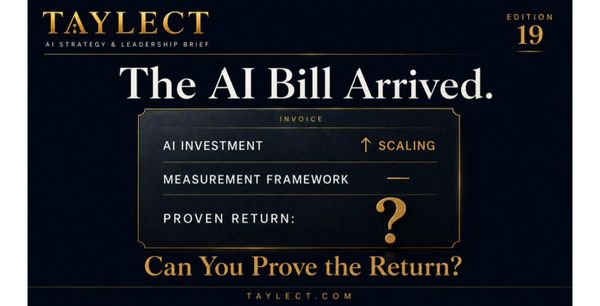
Measurement — Think back to the 100 employees analogy. The organizations that manage people well do not just count headcount. They measure contribution, customer satisfaction, quality, outcomes, and value delivered. The same discipline applies to AI. Cost per resolved case. Revenue per AI-assisted interaction. Cycle-time improvement. Defect reduction. Customer retention. The metric will differ by workflow. The principle does not. If AI is material enough to deserve significant investment, organizations need to demonstrate what that investment produces. Edition nineteen explored exactly that discipline. The post-honeymoon era makes it unavoidable.
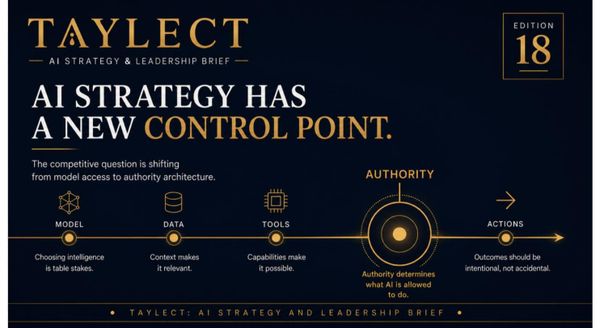
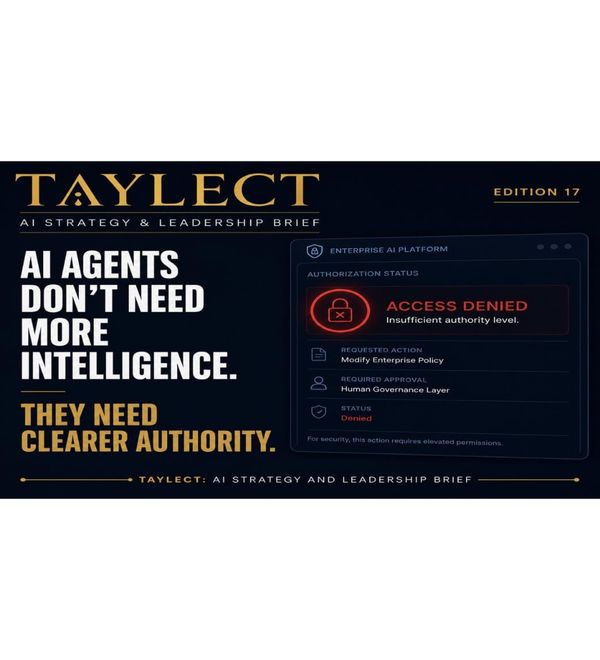
Governance — This week NIST warned that early agentic AI deployments risk repeating a familiar pattern — prioritizing functionality and immediate value while security foundations struggle to keep pace. That warning is particularly relevant for organizations that moved fast during the honeymoon. When agents can interact with applications, data and enterprise systems, the question is no longer only: can we trust the model's answer? It is: what authority have we given the system to act? Who owns the agent? What can it access? What can it modify? Who can stop it? And who is accountable when something goes wrong? Edition eighteen introduced the control point concept. Edition thirteen introduced the AI Employee Framework. As AI moves from answering questions to exercising organizational authority, governance becomes part of the infrastructure required to scale it.
Human Capability — The "horse before the cart" analogy applies here, too. Organizations invested in AI tools before investing in the human capability required to use them well. The 3C Framework Communicate, Think Critically, Stay Curious was never an argument against AI. It was an argument about what AI makes more valuable. Employees need to know when AI deserves trust and when it deserves scrutiny. Managers need to understand what should be automated and what requires judgment. Leaders need to translate technological capability into organizational direction.
Measurement. Governance. Human capability.
Those are not barriers to AI adoption. They are what allow adoption to survive contact with reality.
The Contrarian View
There is another interpretation worth sitting with before drawing conclusions.
Perhaps uneven ROI does not mean the AI opportunity has disappointed.
Perhaps enterprise transformation simply takes longer than markets expected — and some of the value is already present at the workflow and employee level, not yet visible in company-wide financial results.
AI capabilities continue improving. Agent adoption is increasing. Infrastructure investment remains extraordinary.
That is why the lesson is not: slow down because AI was overhyped.
It is: manage differently because AI is becoming operational.
The end of the honeymoon does not mean the relationship failed.
It means the relationship has become real. And real relationships require more than enthusiasm to sustain.
Taylect Perspective
Twenty editions.
Taylect began with one question: what does it actually mean to lead with AI?
Twenty editions later, the answer is becoming clearer.
It means understanding before adopting. Rethinking before replacing. Governing before delegating authority. Measuring before declaring success. And preserving the human judgment required to distinguish between activity and value.
Across twenty editions, we have approached that challenge from different directions.
The governance vacuum. The Simplicity Test. The 4R Framework. The 3C Framework. The AI Employee Framework. Decision dependency. Measurement.
Different subjects. The same underlying question.
Has organizational understanding kept pace with AI adoption?
During the honeymoon, that gap could stay hidden. Scale makes it visible.
Once AI influences customers, employees, decisions, budgets and business processes, understanding can no longer be assumed to follow adoption. It must be built deliberately. Measured honestly. Governed explicitly. And continuously refined.
The organizations that create advantage after the honeymoon will have one thing in common.
They will have built the organizational capability to turn AI from something they use into something they understand how to manage.
That is what Taylect has been building toward for twenty editions.
And it is the foundation for what comes next.
The Decision
The AI honeymoon is over.
Not because AI failed.
Because the stakes changed.
The era of experimentation asked: what can this technology do?
The accountability era asks: what should we do with it, what value is it creating, what authority should it have, and how do we know?
Do not abandon the experimentation that brought you here.
Learn from it.
Rethink what you discovered. Refine what you built. Measure what matters. Govern what gains authority. Develop the human capability required to challenge both the technology and the assumptions surrounding it.
What got organizations through experimentation will not get them through scale.
The next phase requires something more durable than enthusiasm.
It requires management discipline.
And that is where the real AI advantage begins.
Key Insight
The AI honeymoon did not end because AI stopped improving. It ended because experimentation is becoming accountability. The organizations that win the next phase will be the ones that learn to manage AI as deliberately as they learned to adopt it.
Boardroom Discussion
Here is the question worth bringing to your next leadership conversation.
If your organization had to justify every major AI investment today based on business outcomes rather than adoption, which initiatives would you scale, which would you redesign, and which would you stop?
Drop your answer in the comments. I read every one.
If this reframes how your organization thinks about the post-honeymoon moment — share it with one leader responsible for turning AI investment into measurable value.
Continue the Conversation
The post-honeymoon moment will look different in every organization.
Some are still experimenting. Some are scaling agents. Some are discovering that their biggest constraint is governance. Others are confronting measurement, process design, data, skills, cost or leadership alignment.
The important question is no longer whether your organization is doing AI.
It is: what must your organization become better at before its next phase of AI adoption begins?
One Resource Worth Your Time
Momentum AI Austin 2026 takes place September 24 and 25.
Reuters Events describes its central theme as "The AI Honeymoon Is Over; Now Comes the Work" with an agenda focused on moving enterprise AI from experimentation toward measurable business execution.
For leaders responsible for moving AI from experimentation into accountable execution, the agenda is worth reviewing. Available at reutersevents.com.
AI is not a technology race. It is a decision-making advantage.
The organizations that succeed will not simply be those that adopted AI the fastest. They will be the ones that learned when to rethink, what to refine, how to govern growing autonomy, and how to connect AI capability to business value.
Experimentation showed us what AI can do. Accountability will determine its worth.
Dwayne D. Taylor
Publisher, Taylect: AI Strategy and Leadership Brief, taylect.com
The views expressed are my own and do not reflect those of my employer.