What should students still be taught to do when AI can do their homework?
AI is reshaping what students can outsource to a machine, and schools need explicit rules for which cognitive work to protect. Research shows AI helps performance but can quietly erode capability, making "cognitive governance" a leadership decision as much as an educational one.
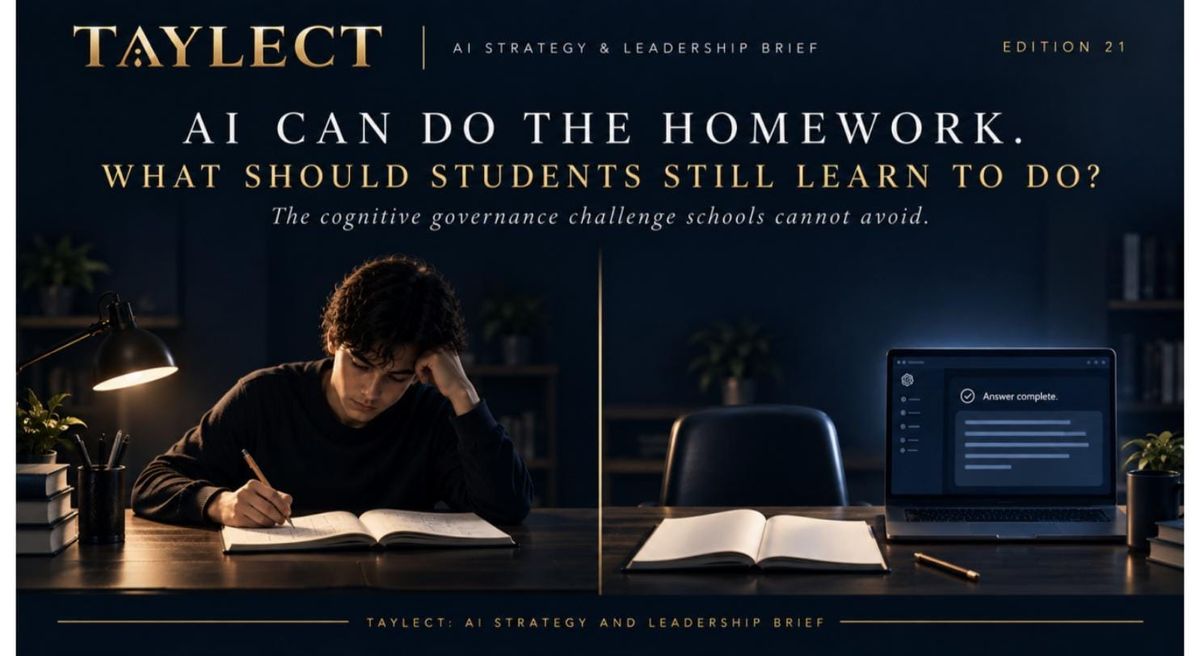
Edition 21 · Where AI Strategy Becomes a Leadership Advantage
The challenge of cognitive governance cannot be avoided by schools.
Executive Brief
The Signal: The introduction of AI into education has outpaced schools' ability to develop the necessary policies, teaching methods, and capabilities to manage it. The challenge is well no longer just a matter of theory. Students can request that an AI explain a concept, critique an argument, solve a mathematical problem, produce an essay, summarize a book, give a presentation, or provide an answer. This represents an important distinction that education systems now need to understand. AI can help a student think. AI can take on the thinking that belongs to the student. They can lead to quite different educational results.
Why It Matters: Research is now starting to explain why this distinction is important. A field experiment with almost 1,000 high-school mathematics students showed that the students who used a general-purpose GPT interface performed better whenever they had access to it. However, after the AI had been taken away, those students who had previously used the unrestricted version then did 17% worse than students who had never had any access. It is important to note that the version designed to act more like a tutor and including safeguards meant to guide students rather than merely give answers largely avoided the negative impact on learning. The lesson extends beyond cheating. A student can increase their productivity through the use of AI yet end up less capable when not using it. It imposes a new responsibility on those in charge of education. I call it cognitive governance.
The Leadership Decision: Schools need to decide what kind of cognitive tasks students should carry out on their own, what kinds should be augmented by AI, and what can safely be handed over. The decision might in the end turn out to be more important than the particular AI products a school selects.
The Problem Is Bigger Than Cheating
It is only natural that the discussion regarding AI in schools should concentrate on academic integrity. Was the essay written by the student? Has AI solved the homework? Was it really their assignment? Those questions matter. But I think they are downstream from a more important one: what was the original intention of the assignment?
Consider an essay. The final document is an output. To produce that document a student has to interpret information, select evidence, construct an argument, organize their ideas, struggle with ambiguity, reconsider flawed reasoning, and communicate clearly. The reason the essay is important is that it involves the kind of thinking needed to write it. Now provide the student with an AI system which is able to produce a believable essay in just a few seconds. The output remains. Part of the cognitive effort may vanish. The issue is that schools should have the responsibility of governing — not AI itself, but the act of outsourcing the kind of thinking that education is meant to foster.
Performance Is Not the Same as Capability
The high-school mathematics experiment is particularly important because it separates two things that are easily confused: performance and capability. Students might achieve better results when help from AI is available. It didn't necessarily indicate that they had learned more. When the help had gone, the difference could be seen.
Another result is just as worth noting. When the researchers made the AI behave more like a tutor who guides students through problems rather than simply giving them the answers, the negative effect on learning was mostly eliminated. That changes the interpretation. The evidence does not indicate that AI is naturally bad for learning. It suggests something more useful: the outcome in terms of education is in part determined by whether or not the AI takes part in the student's thinking or instead replaces it.
AI that asks, "What do you think is the reason for that?" is educationally different from AI that says, "Here is the answer." AI used to critique a student's first draft is not the same as AI used to write the first draft. AI which is able to identify where a student's reasoning went wrong is not the same as AI which eliminates the need for the student to reason through the problem. The same technology can be used. The cognitive result is not.
Schools Now Have a Cognitive Governance Problem
For years organisations have worked on establishing rules and guidelines concerning financial decisions, cybersecurity, data, privacy, risk and, more recently, AI. It is now necessary for schools to have another kind of governance. Cognitive governance involves making deliberate choices regarding which intellectual activities people should carry out, which should be supported by AI, and which can be responsibly delegated.
In the field of education, this question is particularly important since efficiency is not always the aim. Struggle is sometimes the aim: the difficult first paragraph, a mathematics problem which takes twenty minutes, an argument that falls apart halfway through, the instant a student comes to the realization that they have misinterpreted the evidence. Those experiences can seem like a waste of time. Yet the process of learning is generally inefficient. It is sometimes in the case of friction that capability develops. We might unintentionally get rid of some of the learning if we attempt to make every educational task quicker. That is why it is too simple for students to use AI — just as the idea that students need AI skills because AI is the future is the case. Both positions avoid the harder question: at what times does aid from AI enhance human ability and at what times does it instead subtly take over the process by which that ability is developed?
Teachers Are Already in the Middle of This Transition
The observation that remained with me as I considered this edition: teachers are being asked to take charge of a technology that their students have adopted very rapidly, even though many educators are still forming their own understanding of these systems' capabilities, the areas in which they fall short, and how they affect learning. This results in a rather unusual leadership issue. Students did not wait for school systems to make plans for AI. The technology arrived first. Governance followed. At the same time, the people who are responsible for drawing up the boundaries are also developing their own AI capability. It is impossible to govern something that one does not understand. That could well be one of the most important challenges yet to be widely discussed in relation to schools.
The evidence supports the magnitude of the transition. A survey carried out by the England Department for Education in December 2025 revealed that 82 per cent of the primary teachers and 78 per cent of the secondary teachers interviewed had used generative AI as part of their work; typical applications were the production of classroom resources, planning lessons, adapting materials to meet the needs of individual students, and contacting parents. That is important since AI is able to create real value for educators. That is because adoption doesn't mean capability. The data from the OECD TALIS 2024 survey showed that nearly 40 percent of teachers in participating education systems had received training on AI. Yet the OECD report also indicated that three out of four teachers who had not used AI said they lacked the necessary knowledge or skills to teach with it. That means that school leaders have to make an important decision regarding the order of things. You should not expect teachers to regulate how your students use AI unless you first put in the effort to help them understand and assess it. AI literacy for teachers is not just about professional development. It is governance infrastructure.
Three Decisions Every School Should Make
First, decide what students still need to do on their own. Students should have intellectual activities appropriate to their various developmental stages, as identified by the schools — not everything, not nothing. For one assignment, students may use AI only after they have finished a first draft. Another possibility is that students could use AI to question an argument which they had already made. In mathematics, AI could explain why a student's attempted solution did not work, rather than solving the problem from the start. There should still be times when an AI is not there. The governing question should be what ability this activity is meant to develop, and does AI keep or take the cognitive work needed for its development — a superior question to just asking whether AI is permitted.
Second, redesign the assessment in view of the fact that the artifact is no longer evidence of understanding. In the past, education has always placed great emphasis on using artifacts as evidence: the essay, the solution, the presentation, the project. The idea that a student has the required ability can no longer be taken for granted since the creation of a complex artifact does not now serve as proof of that capability. Assessment therefore needs to capture more of the thinking behind the output. Can the student explain the argument? Can they defend their reasoning? Can they identify weaknesses in the evidence? Can they reproduce the underlying capability without AI? Can they recognize when AI is confidently wrong? This does not mean abandoning essays or traditional assignments. It means recognizing that the process increasingly matters as much as the product. Oral defence, classroom discussion, supervised work, iterative drafts, process evidence, personalized questioning, and critique of AI-generated outputs all become more valuable in that environment.
Third, build educator capability before writing increasingly sophisticated rules. AI policies are relatively easy to write. Good judgment is harder to build. Knowing how to prompt an AI system does not make someone AI literate. Teachers need to understand enough to recognize when AI is hallucinating; when students are outsourcing learning; when AI genuinely improves accessibility; when personal information should never enter a system; when bias could affect an output; when AI feedback is useful; and when human judgment should override the machine. The people closest to the student need enough knowledge to make those distinctions. And this is not merely a local issue. The OECD and European Commission's 2026 AI Literacy Framework argues that young people need the knowledge, skills and attitudes to understand AI, critically evaluate its outputs, and use it ethically and creatively. That points toward a more mature model of AI education — not simply how to use AI, but how to judge AI.
The Bigger Question: What Does It Mean to Be AI Literate?
A dangerous assumption is emerging in education: that preparing students for an AI-enabled world means getting them to use more AI. I think that definition is incomplete. AI literacy should also include knowing when not to use AI. A student who can write an excellent prompt but cannot evaluate the answer is not AI literate. A student who can generate an essay but cannot defend its argument is not AI literate. A student who receives an instant answer but has no instinct for whether it makes sense is not AI literate. Real AI literacy requires agency.
The OECD and European Commission's framework defines AI literacy around understanding AI, critically evaluating its outputs, and using it ethically and creatively. The fact that evaluation is given this emphasis is important. In an environment where AI is used, the scarce ability might not lie in coming up with answers. It could be assessing them.
The Taylect Perspective
The Taylect 3C Framework is especially relevant at this point. The framework stresses three capabilities associated with human leadership: to Communicate, to Think Critically, and to Stay Curious.
Communicate: students need to learn to express ideas with clarity and purpose, not merely instruct machines to express those ideas for them.
Think Critically: the greater AI's ability to produce persuasive answers instantly, the more important it becomes to evaluate evidence, challenge assumptions, identify errors, and exercise judgment.
Stay Curious: it is remarkably easy for AI to accept the first plausible answer. Curiosity is what causes someone to ask: is that actually true? What evidence supports it? What perspective is missing? Is there any other explanation?
These are not soft skills. These are the capabilities which determine if a person takes control of AI or ends up depending on it. That is the main lesson. If you know how to use AI but don't think for yourself, you may end up relying on AI too much.
This Is Also a Leadership Pipeline Problem
The consequences go well beyond schools. The students currently in classrooms will one day join organizations in which AI assistance is standard. They will go on to become analysts, managers, entrepreneurs, engineers, healthcare professionals, policymakers, executives, and ultimately board members. Employees who are able to use AI will be something that organizations want. They will also urgently need people who are capable of challenging it.
Imagine two graduates. One person has spent many years learning to get AI to produce sophisticated work. The other has learned how to use AI while retaining the ability to reason independently, evaluate evidence, recognize weak arguments, communicate clearly, and know when not to delegate judgment. Which one would you trust with an important decision?
That is why what happens in schools now matters to leaders who have never worked in education. Schools are not merely deciding how students use technology. They are shaping the cognitive habits of the AI-enabled workforce. And the same question increasingly applies inside organizations: what happens when employees begin delegating analysis, writing, synthesis, research, and eventually judgment to AI not occasionally, but habitually? When does increased productivity turn into a state of dependency? That is why cognitive governance is not ultimately an education issue. It is a leadership issue.
The Decision
Schools do not need to choose between embracing AI and resisting it. That is the wrong choice. They need to decide where AI belongs in the learning process. Use AI where it expands access. Use it where it provides useful feedback. Use it where it helps teachers reclaim time from low-value work. Use it where it allows students to explore ideas more deeply. But preserve the moments when students need to struggle. Preserve the first attempt. Preserve independent reasoning. Make it possible to write, calculate, question, interpret, and judge without the need for a machine. Education has never been merely about coming up with answers. It has been concerned with developing people who are able to reach them. Since answers are becoming more plentiful, this ability might become more valuable than ever.
Key Insight
The risk is not that students will use AI to think. What will happen is that they will eventually cease to notice when it is the AI thinking rather than themselves. It is the role of those in positions of leadership to plan education so that AI enables students to achieve more without reducing what they can achieve even if it is not used.
Boardroom Discussion
Two questions worth bringing into your next leadership conversation: What intellectual abilities should a young person have when answers can be obtained instantly? And inside your own organization: what kinds of thinking are your employees now entrusting to AI that your organization cannot afford to lose?
Continue the Conversation
The similarities between the version of this issue in schools and the one in the workplace are greater than most leaders realize. Where is your organization beginning to see the same cognitive-outsourcing pattern among employees that schools are seeing among students? So what are you doing to address it?
One Resource Worth Your Time
The AI literacy framework for primary and secondary education developed by the OECD and the European Commission should be of interest to decision-makers who go well beyond the field of education. Its importance lies not simply in how it addresses how students should use AI. AI literacy is defined as the ability to understand AI, to assess its outputs critically, and to use it both ethically and creatively. It is increasingly becoming a basic ability for students. Executives are now placing equal importance on it. Read the OECD/European Commission AI Literacy Framework at oecd.org.
AI is not a technology race. It is a decision-making advantage. And the goal of education in the AI era should not be to produce students who never need AI. Nor should it be to produce students who cannot function without it. It should produce people who know the difference.
Dwayne D. Taylor
Publisher, Taylect: AI Strategy and Leadership Brief, taylect.com
The views expressed are my own and do not reflect those of my employer.