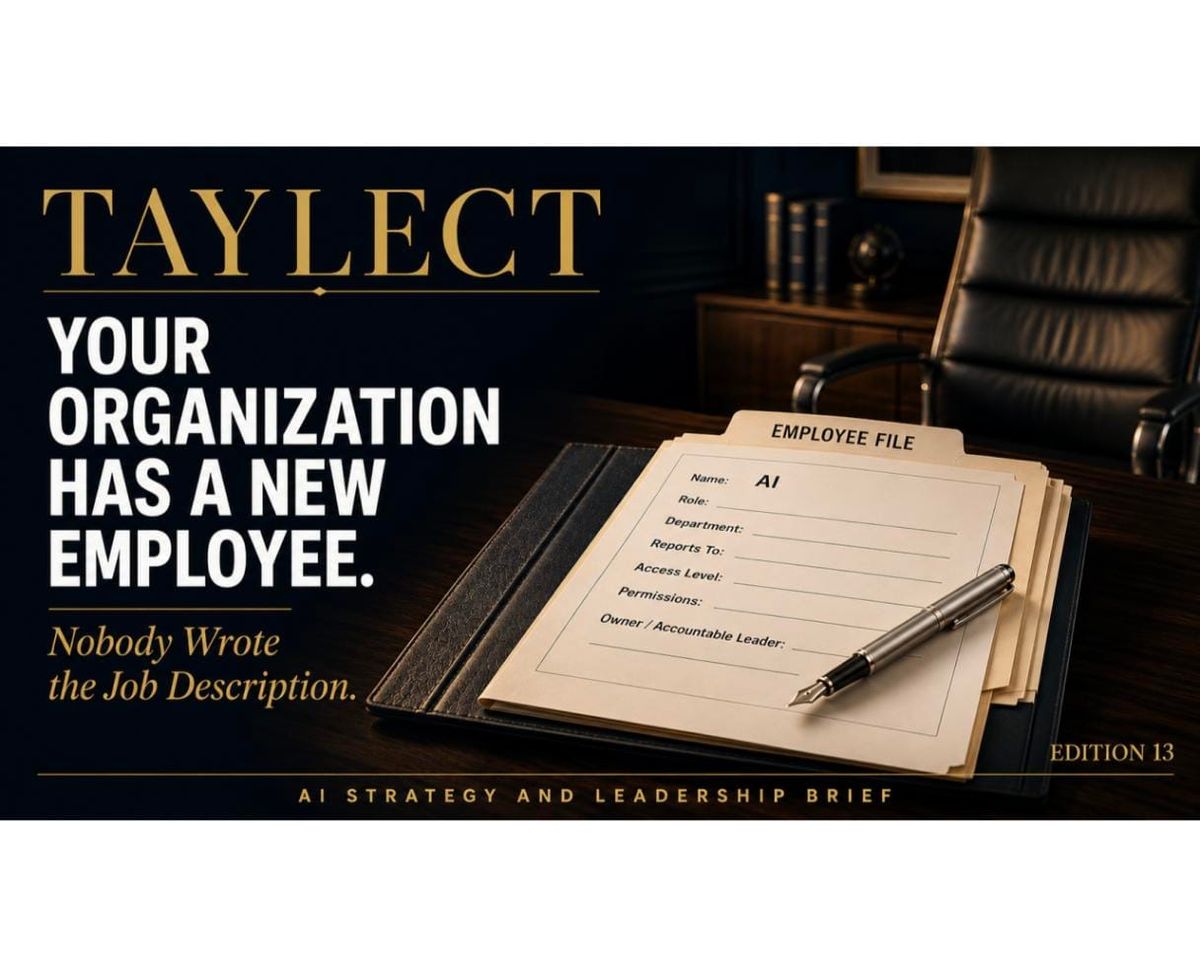
Your Organization Has a New Employee. Nobody Wrote the Job Description.
Every AI operating in your organization has joined the org chart — but almost none of them have a job description. The Taylect AI Employee Framework treats every AI system like a new hire: defined role, access controls, and a named human accountable for its outputs.
Edition 13 · Where AI Strategy Becomes a Leadership Advantage
Why the most urgent AI governance conversation has less to do with technology and everything to do with leadership accountability.
In an era of constant AI noise, leaders don't need more information; they need clarity.
On June 12, 2026, something happened that should change how every board thinks about AI governance.
A US government export-control directive forced Anthropic to suspend global access to its most advanced AI models. Organizations that had integrated those models into critical workflows suddenly lost access without warning and with no immediate recovery timeline.
The disruption lasted 19 days.
For many organizations, it exposed a risk they had never seriously considered.
What happens when the AI your business depends on suddenly becomes unavailable?
That is not primarily a technology question.
It is a leadership question.
And increasingly, it is a governance question.
The Governance Gap That Nobody Is Naming
The pattern that keeps emerging across AI deployments is clear.
Organizations are deploying AI into workflows, operations, and decision-making without applying the same governance standards they demand of every human employee.
Think about what happens when your organization hires someone.
They receive a job description. A defined role. Access appropriate to their responsibilities. A reporting manager. Performance expectations. Accountability for their decisions.
Now think about the AI operating inside your organization.
Does it have a clearly defined role?
Does anyone know precisely what information it can access?
Has someone documented what is authorized and not authorized to do?
Does someone own the outcome when it produces an incorrect recommendation, a biased decision, or an autonomous action that affects a customer?
AI has joined the org chart.
Nobody wrote the job description.
Introducing the Taylect AI Employee Framework
Every AI system should be governed like a new employee. That means every AI operating in your organization should have four things.
A job description: why does it exist, and what business problem does it solve? Defined responsibilities: which decisions are permitted to be supported, and which require human approval? Access controls: which systems can access it, and what information should remain unavailable?
For every enterprise AI agent, leaders should be able to answer three questions: Who are you? (Role and purpose). What can you touch? (Permissions and data access). Who answers for you? (Human accountability).
Every AI agent should have a Job Description (Functional Identity), a Digital Identity (Security Identity), and a Human Identity (Accountability Identity).
Accountability: who owns the outputs and who answers when something goes wrong?
Technology rarely fails because it lacks capability.
It fails because nobody defined responsibility.
The Identity Problem Leaders Do Not See
Most organizations can tell you exactly how many employees they have.
Far fewer can tell you how many AI identities are operating inside their environment.
Today AI exists in Microsoft Copilot, ChatGPT Enterprise, CRM platforms, workflow automation tools, embedded AI features inside existing software, and agentic systems operating across your technology ecosystem.
Each one may access different data. Each one may influence different decisions. Each one introduces different risks.
Yet very few organizations maintain a complete inventory.
You cannot govern what you cannot see.
For every employee, there may already be multiple AI identities operating across your technology ecosystem. Most organizations simply do not know how many.
Dependency Without Governance
The Anthropic disruption was not primarily a technology story.
It was a governance story.
Organizations that managed the disruption well already knew which business processes depended on Anthropic, which workflows could move to alternative models, which decisions required AI and which did not, and who was accountable for activating contingency plans.
Others discovered something different.
They had optimized for adoption.
They had never planned for dependency.
Dependency without governance is not a strategy.
It is an exposure.
The Governance Test
Four questions every leader should answer this quarter.
Does every AI operating inside your organization have a documented job description? Do you have a complete inventory of every AI identity operating across your technology environment? Is there a named leader accountable for every AI-assisted decision? If your primary AI vendor became unavailable tomorrow, which business processes would stop?
If any answer is unclear, your governance work has not started yet.
This Week's Challenge
Choose one AI system currently operating in your organization.
Write its job description.
Define why it exists, what decisions it supports, what information it can access, what it must never do, and who is accountable for its outputs.
If you cannot complete that exercise in 30 minutes, your AI is operating without governance, regardless of how valuable it appears.
Drop your thoughts in the comments. I read every one.
If this changes how you think about AI governance, share it with one leader who is measuring adoption but not accountability.
If you are not yet subscribed to Taylect: taylect.com — every week, one sharp analysis of AI strategy, governance, and leadership. Written from the practitioner's perspective. No hype. Just clarity.
The conversation Canada needs about AI is not happening loudly enough. Taylect is here to change that.
One Resource Worth Your Time
The NIST AI Risk Management Framework remains one of the most practical governance references available for organizations deploying AI responsibly. Pair it with two independent organizations doing the most rigorous accountability work in the field right now: AI Forensics at aiforensics.org, which conducts independent technical investigations into opaque algorithms and holds major platforms accountable, and the Montreal AI Ethics Institute at montrealethics.ai, which provides practical guidance on AI accountability and responsible deployment. Together, they give any leader the evidence base to ask harder questions of their AI vendors and their own governance teams.
AI is not a technology race. It is a decision-making advantage.
The organizations that succeed won't be the ones with the most AI. They will be the ones who govern AI before AI governs them.
Execution, not experimentation, will define the next phase of AI.
Dwayne D. Taylor, Senior Manager, Data Products Excellence & Innovation — Scotiabank, MBA Candidate, AI Leadership — University of Fredericton, Publisher, Taylect: AI Strategy and Leadership Brief
The views expressed are my own and do not reflect those of my employer.
Comments ()