
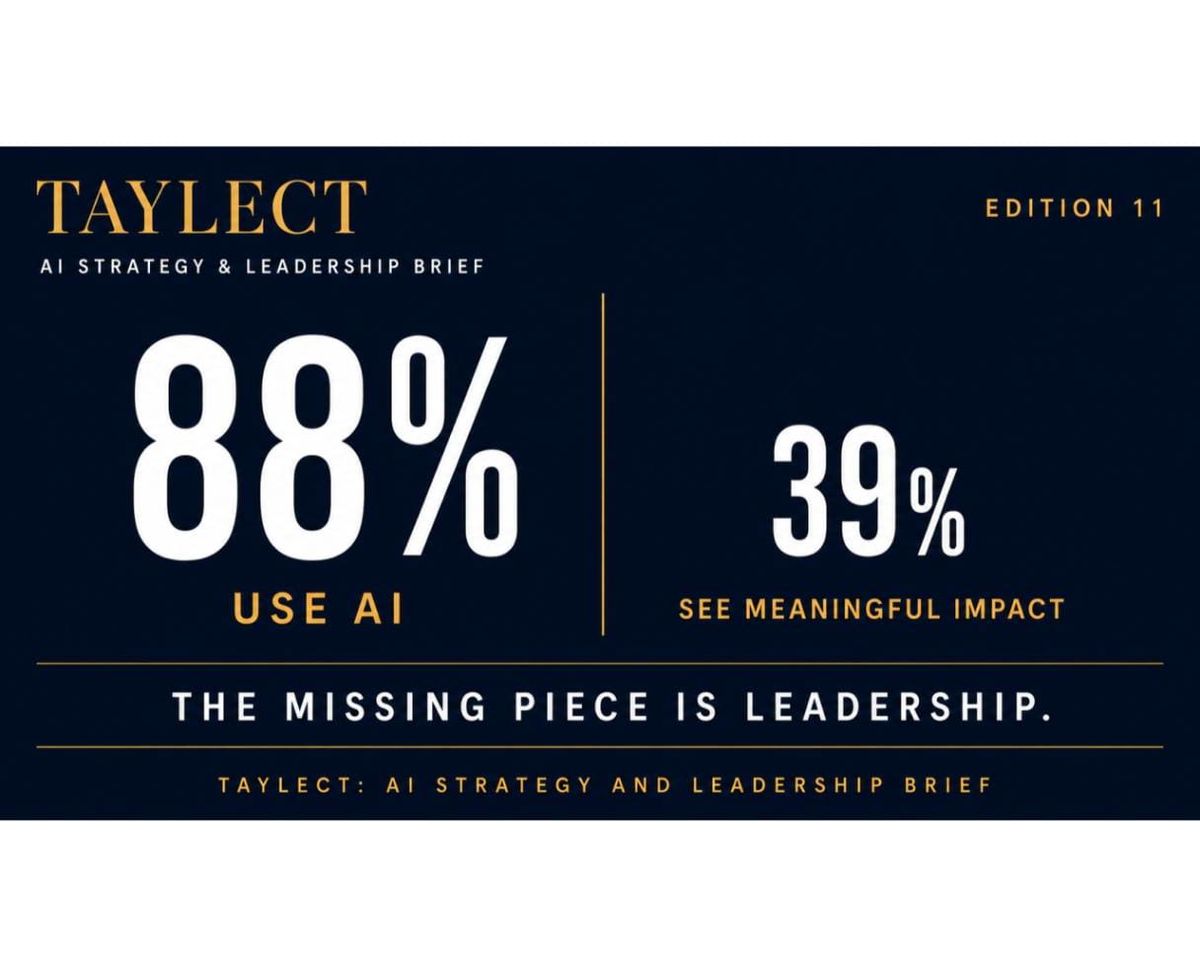
88% Use AI. Only 39% See Meaningful Impact. The Missing Piece Is Leadership.
Microsoft's own 2026 research shows 88% of workers use AI regularly, but only 39% see measurable business impact. That 49-point gap is a leadership failure, not a tools problem.
Edition 11 · Where AI Strategy Becomes a Leadership Advantage
This number should prompt every leader to reconsider how they discuss AI adoption this quarter.
In an era of constant AI noise, leaders don't need more information; they need clarity.
Microsoft released its 2026 Work Trend Index this week.
The headline number is the one Microsoft leads with in every briefing and every sales conversation.
88% of workers now report regular AI use in at least one part of their job.
This figure is designed to impress stakeholders and justify additional licenses, broader rollout, and increased budget.
However, the same report contains another figure that presents a different perspective.
Only 39% of those workers can point to any measurable business impact from that usage.
There is a 49-point gap, measured and published by Microsoft in its own research.
This is not a critic's number. It is Microsoft's own research, and it confirms something I have been writing about since the first edition of Taylect.
Adoption does not equate to understanding, and the gap between them is not closing without intervention.
The week this landed, it was different for me.
Recently, I prepared to demonstrate to colleagues how I use AI productivity tools in my daily work.
The request seemed straightforward: demonstrate the tools, review use cases, and answer questions.
However, preparing for this revealed an unexpected insight.
Most of my daily use of these tools has little to do with their features.
It largely depends on the quality of the questions I pose, the context I provide, and my ability to discern which outputs are reliable and which require further review.
These are not technical skills, but rather leadership and judgment skills applied through the tool.
Microsoft's data now confirms this distinction at scale.
What the Numbers Actually Reveal
Enterprise AI adoption figures suggest inevitability, but a deeper analysis reveals a more complex reality.
Microsoft's own data on Copilot — its flagship enterprise AI product — is where the gap becomes undeniable.
Microsoft Copilot's workplace conversion rate is 35.8%, indicating that approximately 64% of employees with access do not use it. When employees can choose between Copilot and ChatGPT, only 18% select Copilot. When all major platforms are available, Copilot's share drops to 8%.
Trust is a significant factor. Recon Analytics tracked Copilot's accuracy Net Promoter Score at three points last year; it declined from -3.5 to -24.1 before partially recovering to -19.8. Of those who stopped using Copilot, 44.2% cited distrust of its answers as the primary reason.
This does not indicate the tool is flawed. Instead, access was expanded more rapidly than understanding, which is the core warning of the Taylect 4R Framework.
AI replicates what you give it.
Providing an organization with a powerful tool without first developing the necessary judgment does not result in widespread capability.
Instead, it leads to widespread uncertainty, misrepresented as adoption.
Why This Is a Leadership Gap, Not a Tools Gap
It may be tempting to interpret Microsoft's numbers as a Copilot issue, but this is not the case.
This pattern appears with every AI tool, platform, and rollout in organizations striving to meet adoption targets. Licenses are distributed, training sessions are scheduled, and adoption is declared.
However, the more critical questions are often overlooked.
Do the people using this actually understand what it is for, when to trust it, and when to override it?
That question is the entire premise of the Simplicity Test I wrote about in edition eight. It is the first stage of the 4R Framework I introduced in edition nine — Rethink, before you Replicate. And it is exactly what Microsoft's own research is now proving at a scale no single organization's internal numbers could ever demonstrate.
88% adoption with 39% impact is not a technology failure.
It is a leadership failure.
This occurs when organizations prioritize access over the more challenging task of building understanding.
What Leaders Should Actually Do With This Number
Do not measure AI success solely by license counts or login frequency.
Those metrics tell you who has access.
They do not tell you who has the capability.
Before your next rollout, ask a different question: How many users can clearly explain what problem the tool solves for them and when its outputs should not be trusted?
Approach every adoption initiative as an opportunity to rethink, not merely replicate. Before expanding access, assess what the current gap between usage and impact reveals about your organization's initial rollout.
This Week's Challenge
Think about the AI tools currently deployed across your organization.
If you asked ten users to explain in one sentence what problem the tool solves for them, how many could provide a clear answer?
Please share your response in the comments. I review each one.
If this number has influenced your perspective on your organization's AI rollout, consider sharing it with a leader who currently measures adoption rather than impact.
If you are not yet subscribed to Taylect: taylect.com — each week, receive a concise analysis of AI strategy, governance, and leadership from a practitioner's perspective. No hype, just clarity.
The necessary conversation about AI in Canada is not receiving sufficient attention. Taylect is here to change that.
One Resource Worth Your Time
Microsoft's 2026 Work Trend Index is publicly available and worth reading in full, not just for the 88% headline figure but for the underlying insights. It is uncommon for a company to publish research that challenges its own sales narrative, which enhances its credibility.
AI is not a technology race. It is a decision-making advantage.
The organizations that succeed won't be the ones with the most AI. They will be the ones with the best judgment.
That is the leadership gap Microsoft's data has finally put a number on.
Execution, not experimentation, will define the next phase of AI.
Dwayne D. Taylor, Senior Manager, Data Products Excellence & Innovation — Scotiabank, MBA Candidate, AI Leadership — University of Fredericton, Publisher, Taylect: AI Strategy and Leadership Brief
The views expressed are my own and do not reflect those of my employer.


Comments ()