
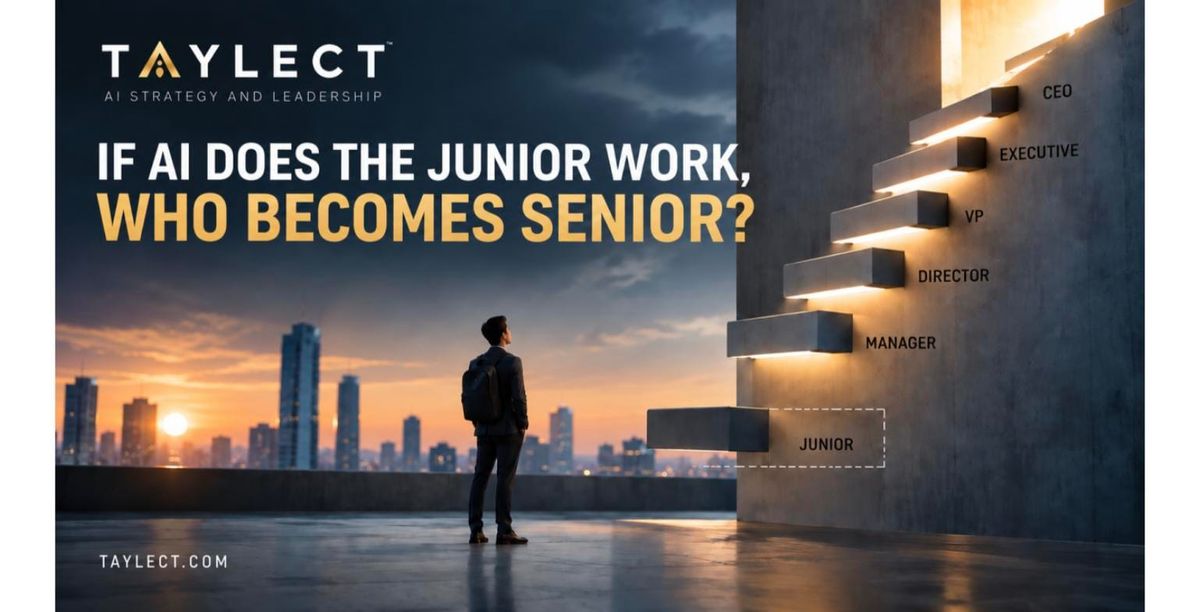
If AI Does the Junior Work, Who Becomes Senior?
Early evidence suggests AI is hitting the labour market through fewer entry-level hires, not layoffs. Taylect argues leaders must separate which junior tasks AI should absorb from which junior development experiences must survive, or risk trading their future leadership pipeline for today's savings.
Edition 23 · Where AI Strategy Becomes a Leadership Advantage
Layoffs are easy to see. The job that was never created is much harder to notice.
As organizations use AI to automate more junior work, the immediate productivity gains are increasingly visible. Less visible is what may happen to the pathways through which inexperienced employees become experienced ones.
That creates a leadership question that goes beyond headcount:
If AI does more of the work where people traditionally gain experience, how will organizations develop the managers and leaders they will need tomorrow
Executive Brief
The Signal: the first noticeable effect of AI on the labour market isn't widespread worker displacement. It is the cessation of hiring at the lower rungs of the career ladder. Stanford, the Bank of Canada and Gartner all identify the same cause: fewer opportunities being created, not more people being pushed out.
This matters because entry-level work was never merely a collection of tasks; it was how people acquired experience, judgment, and institutional knowledge. If you automate the task without replacing the development that it generated, organizations may end up exchanging the leadership pipeline they will need in the next decade for the headcount they have this year.
The Leadership Decision: Leaders need to separate two decisions that currently look like one: which junior tasks should disappear, and which junior development experiences must survive regardless. Get this wrong, and it won't show up on next year's income statement; it shows up years later, when the experienced people aren't there.
The signal is showing itself in the hiring process.
Researchers at Stanford's Digital Economy Lab have been monitoring payroll data for millions of workers in the United States.
The most recent analysis finds no widespread job displacement across the economy due to AI.
But hidden behind that reassuring headline is a significant difference.
For workers between the ages of 22 and 25 who are employed in occupations with high exposure to AI, employment levels are now approximately 19 per cent lower than they would have been if they had kept up with similarly aged workers in occupations with less exposure to AI.
Experience among workers shows no similar gap.
What is even more interesting is the fact that the adjustment seems to be taking place.
Mainly by cutting down on hiring, not by increasing the number of separations.
That doesn't prove that AI was the cause of the decline. The Stanford researchers clearly warn against considering the one study as definitive evidence and admit that there are questions regarding causality and the extent to which their payroll sample reflects the wider economy.
That pattern is worth noting.
The researchers also discover that in those occupations where AI is likely to automate human jobs, early-career employment has declined more. In cases where AI is used mainly to assist workers, employment has remained comparatively stable or has increased.
The difference might ultimately turn out to be more important than just asking if a job is "exposed to AI."
A key question might then be whether or not AI is assisting a person in carrying out the job, or whether it is decreasing the need to hire someone to do the job.
Canada is showing a similar trend.
The pattern is not limited to the United States.
Recently, researchers at the Bank of Canada looked at the employment outcomes among occupations that have different levels of exposure to AI.
Workers who were looking for jobs in occupations with a high level of AI exposure have found it more difficult to secure employment.
The mechanism is important here because the decline was mainly seen in the rates at which people found jobs, not in the rates at which people lost jobs. That is to say, the main feature was not that people were losing the jobs they had. It was that they were having more trouble in obtaining jobs initially.
Statistics Canada provides a valuable point of view; its analysis showed that Canadian employment generally kept on increasing among occupations that had different levels of AI exposure from November 2022 to December 2025 and it found no statistically significant evidence that younger workers in the most AI-exposed occupations were experiencing unique employment declines.
But one thing is clear: employment in coding-intensive occupations among Canadians aged 15 to 29 remained roughly the same between November 2022 and December 2025. For those aged 30 to 49, it increased by almost 30%. The number of vacancies requiring three years of experience or less decreased much more sharply in coding-intensive occupations than the number of vacancies requiring more experience.
Statistics Canada warns that the adjustment in technology hiring since the pandemic could help account for that difference.
Once more, the evidence fails to show a crisis involving AI workers; instead, it points to something more valuable: keep an eye on the front door.
Companies are already making the decision.
Labour market statistics will always lag behind the actions of those in charge within organizations.
Employer surveys also offer a clue.
According to a Gartner survey of 110 HR heads, 22 percent said at least one business leader in their organization had stopped hiring for entry-level positions because of AI automation.
Gartner also found a striking contradiction: although 95 percent of the organizations surveyed had implemented AI in some form, only one in five said they had achieved significant or transformational value.
Take the two findings together. Although some organizations have already altered their hiring decisions based on AI, most have not shown that it has brought about transformative value.
This leads to an uncomfortable question for leaders: are businesses being used to reduce the size of tomorrow's workforce on the basis of the productivity they expect AI to achieve today?
The evidence does not apply in all cases.
It's simple to turn these findings into a sensational forecast concerning the disappearance of entry-level jobs.
The evidence does not back that claim.
The United Kingdom is an appropriate example since hiring in the country fell by 14% compared to the previous year in April 2026. For most of the occupations looked at by the Department for Science, Innovation and Technology, recruitment at the entry level was poor. Roles involving the application of knowledge were some of the most affected. Entry-level hiring for accountants declined by 29 per cent, graphic designers by 28 per cent, and software engineers by 27 per cent. These are precisely the types of jobs in which generative AI capabilities have developed rapidly.
Broadly speaking, recruitment at the entry level was declining in keeping with the rest of the labour market, and as a result the UK government decided that it was necessary to carry out further research before attributing those changes to AI.
The same degree of caution should be applied in the European case. In some knowledge-intensive industries, youth employment in the euro area has declined significantly. Employment among young people fell by 18.6% in the information and communications technology sector between early 2023 and early 2026. However, the European Central Bank's analysis shows that general economic conditions account for a large part of this decline and does not identify generative AI as the cause.
The appropriate conclusion therefore is not that AI is getting rid of entry-level jobs.
What is happening is that there are emerging indications that AI could be influencing hiring for early-career workers in certain occupations and sectors, but this effect is not universal and has not been definitively proven to be causal.
For leaders, uncertainty should not end the discussion; it should start a new one.
The purpose of starting work is two-fold.
Most organizations view the work of junior staff mainly from an economic point of view. They ask what the person produces, how much the work costs, and whether software could do it more quickly.
These are reasonable questions, but they overlook another role of junior work.
Development.
A junior accountant does more than just reconcile figures; they also find out where the figures come from.
A junior developer does not limit themselves to writing basic code; instead, they learn why systems were designed the way they were.
An inexperienced consultant does more than draw up analyses; they learn how clients make decisions.
A customer-service worker does not merely respond to standard questions; they also learn where customers struggle and where processes fail.
Gradually, the stages progress from task to experience, then to judgment, then to responsibility, and finally to leadership.
Even if AI can take over that task, organizations still have to consider what happens to all the steps which used to come after it.
The efficiency trap
Picture a company which has 100 analysts and imagine that AI allows them to carry out 20% more work.
A obvious reply would be to fail to employ the next 20 analysts.
From a cost point of view, that might be entirely reasonable. There would be fewer workers, each producing more output, with lower operating expenses and possibly better profit margins.
However, companies do not work on a quarter-by-quarter basis.
A number of the junior analysts would go on to become senior analysts. Others would rise to management positions. Some would become directors. Maybe a few would reach executive level. Along the way they would have gained customer knowledge, institutional memory, professional judgment and relationships.
The organisation has not just got rid of 20 jobs; it might have eliminated 20 opportunities for the development of future expertise.
The effects need not be seen on next year's income statement; they might show up years later, when the company has to rely on experienced personnel and realizes that it had stopped producing them.
Gartner is currently cautions against this possibility. It states that companies that eliminate their early-career recruitment pipelines may eventually have to pay higher prices for experienced staff developed elsewhere. In the case of supply-chain organizations in particular, Gartner forecasts that many employers who have suspended entry-level hiring due to AI could end up paying considerably more for early-career professionals by 2030.
That prediction may prove correct or not; either way, leadership should pay attention to this fundamental issue now.
The traditional career ladder could vanish.
There is another possibility.
Training people through entry-level jobs was never very effective, since we mistook repetition for learning.
Does spending hours formatting presentations actually develop tomorrow's executives? Does manually searching through documents build judgment? Does writing boilerplate code develop leadership? Does handling routine requests develop expertise?
It might have, and it might not have. AI enables companies to tell the two apart.
Because AI takes over low-value production work, younger employees will have more time to talk to customers, solve problems, assess the AI, run experiments, take part in cross-functional projects, make decisions, provide mentorship, and work directly with more experienced colleagues.
In that situation, AI does not destroy the career ladder but rather reshapes it. A junior employee using AI could get to worthwhile work earlier than members of previous generations had.
That is the more optimistic scenario, and it shows that merely keeping existing junior positions wouldn't be the solution.
The incorrect question is "How many junior employees do we still need?" The more appropriate one is "How can people gain experience in an organization in which AI carries out much of the work that beginners used to do?"
That is an entirely different approach to the workforce.
According to a study by the World Economic Forum, more than one in every three young workers currently hold jobs that involve medium-to-high exposure to AI-driven changes in tasks. The Forum's 2026 report sees job access, job design, talent pipelines, and education alignment as interconnected challenges, not viewing entry-level employment as merely a matter of headcount.
It therefore means that leaders will have to treat as separate the two decisions which at present appear to be a single one—namely, which junior tasks should be discarded and which junior development experiences should be retained. The answers to these questions need not be the same.
AI might create a brand-new type of beginner.
Another reason not to assume the traditional career ladder survives unchanged is this:
Inexperienced employees can make use of capabilities that it took members of previous generations years to acquire. A junior analyst is able to examine datasets. A new marketer can look at customer research. A developer can check out unfamiliar code. An associate is able to quickly get a grasp of an industry.
Just because they have access to an answer doesn't mean that they are experts; having access to it is not the same as understanding why it is correct.
However, it might affect the speed at which people become useful. As a result, the future entry-level employee will therefore carry out less production and more evaluation, involving less searching and more questioning, as well as less assembling and more deciding.
This places a high value on abilities that are distinctly human—namely, the ability to communicate clearly, to think critically, and to remain curious enough to question what AI produces.
The chance to lead does not consist in keeping all the jobs exactly the way they are; rather, it consists in redesigning the work for early-career employees around the abilities that they will need when AI is already a part of the team.
The leadership pipeline could be the overlooked AI metric.
The majority of organizations currently assessing AI concentrate on productivity, looking at the time that has been saved, the costs that have been reduced, the tasks that have been automated, and the revenue that has been generated.
The metrics are important, but workforce transformation might need another one: capability created.
If AI saves 10,000 hours but removes the experiences through which future experts develop, was the organization really more productive?
If a department cuts graduate hiring by 30% but must later compete aggressively for experienced talent, what was the true return?
If junior employees never perform the underlying work, can they effectively evaluate AI when it gets that work wrong?
Those aren't arguments against automation. They are arguments for measuring its second-order effects.
Leaders should redesign before they reduce
This leads to a practical principle.
Before removing an entry-level role because AI can perform some of its tasks, leaders should ask four questions.
What work is AI actually eliminating? Separate tasks from jobs. A role containing automatable work may still contain important developmental experiences.
What capability did that work historically create? Perhaps none. If so, automate it. But if performing the work helped people develop judgment, customer understanding or institutional knowledge, identify another way to build those capabilities.
Where will our experienced talent come from? If the answer is "we'll hire it," remember that every organization cannot simultaneously stop developing people and expect someone else to supply experienced workers.
What should a beginner do now? Don't preserve low-value work simply because it has always been assigned to junior employees. Create a better apprenticeship for an AI-enabled organization.
This isn't a prediction about jobs.
The evidence remains too early for confident declarations about what AI will ultimately do to employment.
Stanford's researchers say so. The Bank of Canada says so. Statistics Canada says so. The UK government says so. European evidence remains similarly uncertain.
That uncertainty is precisely why leadership matters. Executives can't wait until economists can definitively measure a transformation before deciding on hiring, development, and organizational design. Those decisions are already being made.
The question is whether organizations make them narrowly, optimizing today's headcount, or strategically, considering the capabilities they will need tomorrow.
AI may eventually prove capable of doing much of the work we once gave beginners. That doesn't eliminate the need for beginners. It makes developing them a leadership responsibility, not a by-product of giving them the work nobody else wanted.
Key Insight
The career ladder isn't being removed. Its bottom rung is not being rebuilt.
The Question
If your organization has quietly slowed entry-level hiring this year, could you say precisely which capabilities you're no longer building for the future?
And on a more personal note, where in your own career did junior work teach you something no shortcut could have? I'd be interested in where other leaders are drawing that line.
One Resource Worth Your Time
Stanford Digital Economy Lab Canaries in the Coal Mine? Six Facts About the Recent Employment Effects of Artificial Intelligence
This is the paper behind the 19% figure, and it's worth reading directly rather than through secondhand summaries. The authors are unusually careful distinguishing correlation from causation, and their codified-versus-tacit-knowledge framing is the clearest explanation I've seen for why this is hitting some roles and not others.
AI is not a technology race.
It is a decision-making advantage.
The organizations that thrive over the next decade won't be the ones that automated the most work. They'll be the ones that kept building the people who could do the work AI couldn't.
Execution, not experimentation, will define the next phase of AI.
Dwayne D. Taylor, Publisher, Taylect: AI Strategy and Leadership Brief
taylect.com
The views expressed are my own and do not reflect those of my employer.

Comments ()