AI Adoption Is Rising. AI Understanding Is Not.
Ten editions of Taylect later, the real story isn't AI strategy. It's the widening gap between AI adoption and AI understanding.
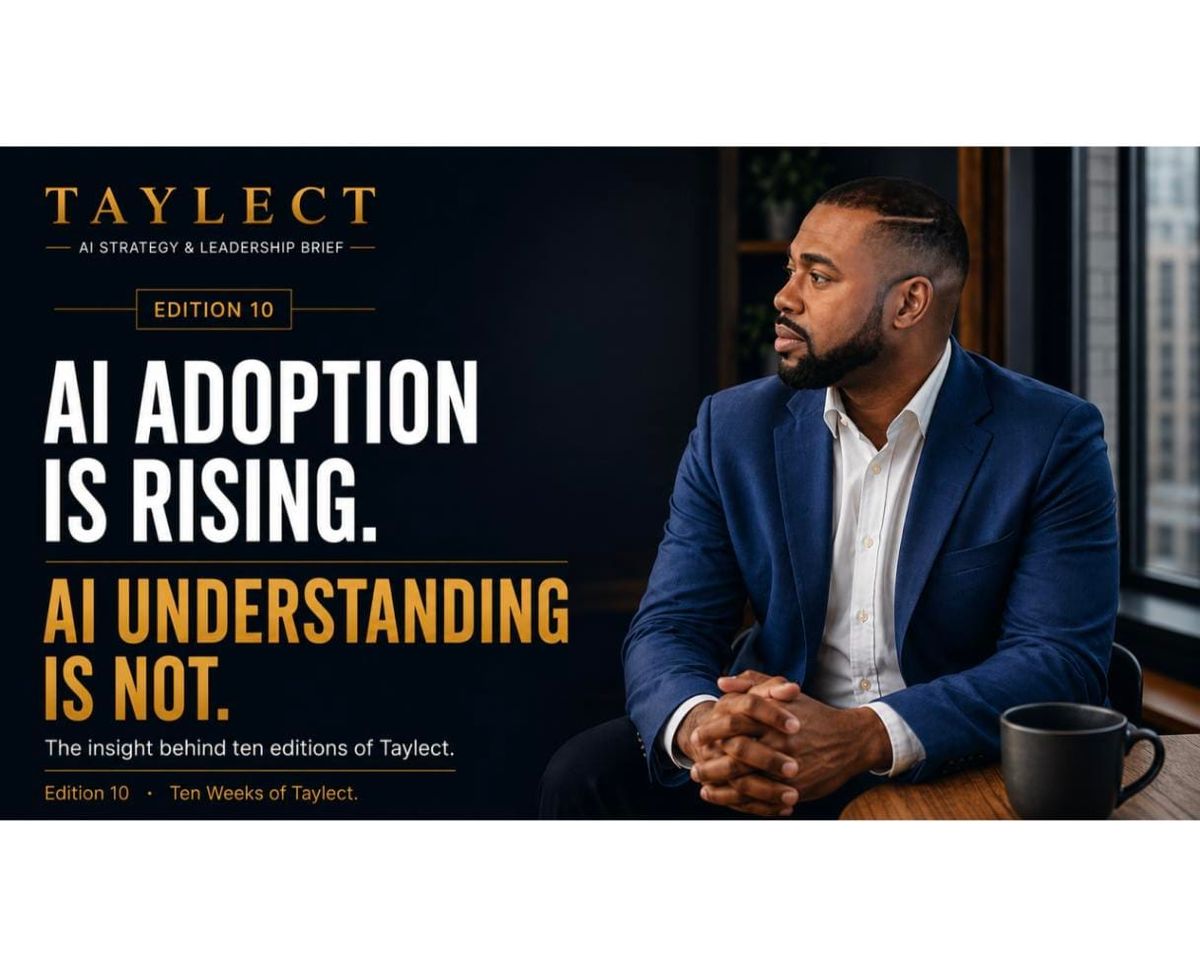
Edition 10 · Where AI Strategy Becomes a Leadership Advantage
The insight behind ten editions of Taylect.
In an era of constant AI noise, leaders don't need more information; they need clarity.
Ten editions ago, I started writing Taylect with one question.
What does it actually mean to lead with AI?
I expected to find answers in the research. In the data. In the frameworks, policy documents, and executive surveys.
What I did not expect was to find them in the gaps.
The gap between what organizations say about AI and what they actually do with it.
The gap between what leaders claim to understand and what their teams reveal when you ask the right questions.
The recurring theme is the gap between AI adoption and understanding.
Ten editions later, that gap has become impossible to ignore.
And that's why Taylect exists.
What I Thought I Was Building, And What It Became
When I published Edition 01, I thought I was writing a newsletter about AI strategy.
Canada had just lost its proposed AI legislation. Leaders were making consequential decisions without a regulatory framework to guide them. The governance story seemed clear.
But something happened between Edition 01 and Edition 10 that I did not anticipate.
Regardless of the topic, every edition kept circling the same underlying question.
Not what AI can do.
But whether the people deploying it actually understand what they are doing.
The Hollywood edition asked whether organizations had drawn the line on AI accountability.
The Agentic AI edition asked whether governance frameworks were prepared for systems that act without direct human approval.
The Amsterdam edition asked whether organizations were deploying AI strategically or simply visibly.
The Simplicity Test asked whether teams could explain AI to customers in plain language.
The 4R Framework asked whether organizations were rethinking before replacing.
Different topics.
The same fundamental question was present throughout.
And that realization changed how I think about AI leadership.
Confession One — I Thought This Was About AI Strategy
It isn't.
At least not primarily.
The gap between AI adoption and AI understanding is not a technology problem.
It is a leadership problem.
Across ten editions, one pattern appeared repeatedly.
Organizations rarely struggle because the models are inadequate.
They struggle because the thinking surrounding the technology is inadequate.
They have not asked why before asking how.
They have not defined what good looks like before measuring whether AI produced it.
They have not built the organizational understanding that turns technology into an advantage.
Technology scales what already exists.
Understanding determines whether what gets scaled is useful.
What surprised me most was not how quickly AI is advancing.
It was how slowly organizational thinking was evolving alongside it.
Confession Two — The Editions I Was Least Certain About Performed Best
Edition 07 almost did not get written.
I was in Amsterdam for an international field study, and I had nothing. No angle. No opening line. Just a deadline.
Then Fausto Albers offered a simple reframe.
AI is not a tool. It is a worker. You are its manager.
That insight became one of the most engaging editions Taylect has published.
Edition 08 followed a similar pattern.
The Simplicity Test was written almost entirely from observation rather than research.
I worried it might be too simple.
Instead, it became one of the strongest responses Taylect has received.
The lesson was unexpected.
Certainty produces polished content.
Uncertainty produces honest content.
And readers consistently respond to the honest version.
Confession Three — My Most Useful Insight Came From the Edge of My Expertise
I am not a consultant.
I am a practitioner.
An MBA candidate in AI Leadership.
Someone who has spent years observing automation inside complex, regulated environments.
The 4R Framework emerged from those observations.
Not consulting theory.
Not academic modelling.
Observation.
Organizations that struggled almost always skipped the rethink.
They automated processes they did not fully understand.
AI replicated the flaw.
The reveal surfaced what should have been discovered before deployment.
The refining stage became recovery rather than improvement.
That pattern appeared repeatedly.
And it taught me something important.
You do not need to be the most qualified person in the room to offer a useful perspective.
You need to be willing to observe honestly and describe what you see.
What Ten Editions Taught Me About AI Leadership
I started writing about AI strategy.
I ended up writing about organizational self-awareness.
The organizations succeeding with AI are rarely the ones with the largest budgets or the most sophisticated models.
They are the ones who ask harder questions before they move.
They build understanding before capability.
They treat what AI reveals about their processes, governance, and culture as intelligence rather than an inconvenience.
That insight underpins every edition of Taylect.
The Simplicity Test. The 4R Framework. The Amsterdam field study. The governance discussions.
Different lenses.
The same conclusion.
AI adoption is rising.
AI understanding is not.
Leaders are responsible for closing that gap.
This Week's Challenge
Ten editions in, what has genuinely changed in how you think about AI leadership?
Not what the research says.
Not what your organization's strategy document says.
What has actually shifted in your thinking?
Drop your answer in the comments. I read every one.
If Taylect has been useful, share it with one leader who needs this conversation.
If you are not yet subscribed to Taylect: taylect.com — every week, one sharp analysis of AI strategy, governance, and leadership. Written from the practitioner's perspective. No hype. Just clarity.
The conversation Canada needs about AI isn't loud enough. Taylect is here to change that.
AI is not a technology race. It is a decision-making advantage.
The winners in AI won't have better models. They'll have better understanding.
Execution — not experimentation — will define the next phase of AI.
Dwayne D. Taylor
Senior Manager, Data Products Excellence & Innovation — Scotiabank
MBA Candidate, AI Leadership — University of Fredericton
Publisher, Taylect: AI Strategy and Leadership Brief
The views expressed are my own and do not reflect those of my employer.

Comments ()