AI Doesn't Just Change Organizations. It Reveals Them.
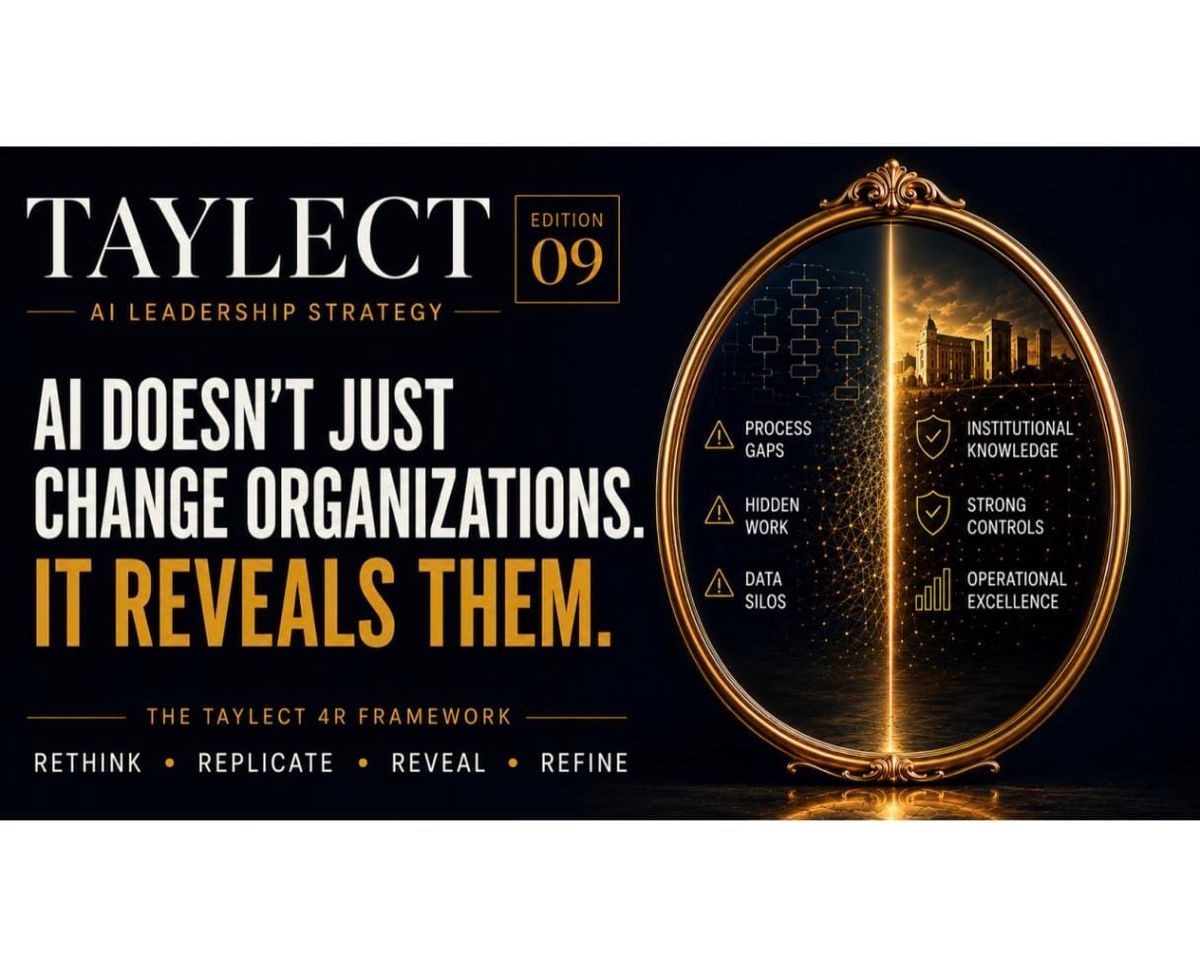
Introducing the Taylect 4R Framework: Rethink, Replicate, Reveal, Refine. Why AI doesn't just change your organization, it exposes what was already there.
Edition 09 · Where AI Strategy Becomes a Leadership Advantage
Introducing the Taylect 4R Framework: Rethink. Replicate. Reveal. Refine.
Most leaders think AI implementation is about introducing something new.
My experience has been the opposite.
The most important thing AI does is reveal what was already there.
Weak processes. Hidden dependencies. Governance gaps. Institutional strengths.
AI does not create these realities. It exposes them.
That insight became the foundation for what I now call the Taylect 4R Framework.
The insight behind this framework comes from years of observing automation and AI implementations across complex, regulated environments. What repeatedly emerges is that success has less to do with the technology itself and more to do with how organizations prepare for, govern, and learn from its deployment.
The organizations that succeed with AI are not necessarily the ones moving fastest.
They are the ones who thought most carefully before they moved at all.
The Taylect 4R Framework is a practical guide for leaders who want to implement AI in a way that creates genuine, sustainable value — not just visible activity.
Four stages. Each one builds on the last. Each one reveals something about your organization that the previous stage made possible.
Rethink. Replicate. Reveal. Refine.
Why Most AI Implementations Fall Short
Before introducing the framework, it is worth naming the pattern I see most often.
An organization identifies a process that could be improved. AI is proposed as the solution. A project is launched. Tools are deployed. Adoption is declared.
Six months later, the efficiency gains are smaller than expected. Resistance is higher than anticipated. And somewhere in the implementation, a problem nobody named at the start has quietly compounded into something harder to solve.
The failure almost never starts with the technology.
It starts with what happened — or did not happen — before the technology arrived.
Most organizations skip the most important step. They move directly to implementation without first asking the harder question.
Why do we do this, and is there a better way?
That question is the first R.
R1 — Rethink
Rethinking is where every successful AI implementation begins.
Before deploying AI into any process, leaders need to interrogate that process honestly.
Not: how do we automate this? But: why does this process exist in its current form? What problem was it designed to solve? Where does it break down? Who compensates for its weaknesses — and how?
That last question is often the most important.
In many organizations, experienced people have quietly been compensating for process gaps for years. Their judgment. Their workarounds. Their institutional knowledge. These invisible contributions are often what keep the process functioning.
When AI arrives, it does not inherit those workarounds. It inherits the documented process.
If the documented process is not the real process — if the real process lives in the heads of the people who have been quietly fixing it — the implementation will struggle in ways that are difficult to diagnose.
Rethink asks: why do we do this, and is there a better way?
R2 — Replicate
Once a process has been rethought, improved, and properly understood, AI can be deployed to replicate it at scale.
This stage carries a simple but critical warning.
AI replicates what you give it.
Give it a sound process, and it replicates excellence. Give it a flawed process, and it replicates flaws faster, wider, at greater scale.
The quality of your replication is entirely determined by the quality of your rethinking.
This is why Rethink is not optional. Organizations that skip it and move directly to Replicate are not accelerating their implementation. They are accelerating their exposure.
Replicate asks: what expertise should be available everywhere — and are we certain that expertise is sound?
R3 — Reveal
This is where the framework becomes most valuable.
Once AI is deployed and replication is underway, something unexpected often happens.
The implementation starts showing you things about your organization that were previously invisible.
Processes that appeared consistent but are not. Data quality issues that people were manually correcting. Governance gaps that nobody had formally acknowledged. Hidden work that exists outside documented systems. Cultural resistance that signals deeper organizational concerns.
This is what I mean when I say AI does not just change organizations. It reveals them.
For organizations that invested time in Rethink, the Reveal often uncovers strengths — strong governance, excellent processes, deep expertise, institutional capabilities worth scaling.
For organizations that rushed implementation, the Reveal often exposes weaknesses that should have been discovered before deployment.
The Reveal is not the problem. The Reveal is the diagnosis.
AI becomes a mirror. And what appears in that reflection determines what happens next.
Reveal asks: what is AI showing us about our organization that we could not see before?
R4 — Refine
Refine is where AI implementation becomes a discipline rather than a project.
Everything that surfaced during the Reveal stage becomes an opportunity for improvement.
Processes are redesigned. Data quality is strengthened. Governance is enhanced. Roles become clearer. Controls become stronger.
Most importantly, the intelligence gained through one implementation cycle feeds directly into the next Rethink.
This is why the Taylect 4R Framework is not a checklist. It is a cycle.
Every refinement creates a better starting point for the next Rethink. Organizations that treat AI as a one-time project will always be outpaced by organizations that treat it as a continuous learning system.
Refine asks: how do we improve the system based on what AI has shown us?
The Framework in Practice
Before your next AI initiative, ask four questions.
Have we genuinely rethought this process, or are we automating something we do not fully understand? Are we certain that what we are replicating at scale is worth replicating? Are we prepared for what the implementation will reveal about our organization? Do we have the discipline to refine based on what we learn and feed that intelligence back into the next cycle?
If the answer to any of those questions is uncertain, start with Rethink.
Because the true measure of AI success is not the sophistication of the technology deployed.
It is the organizational intelligence built through every stage of the journey.
This Week's Challenge
Think about one AI initiative currently underway — or recently completed — in your organization.
Which stage of the 4R Framework did it skip? And what did that cost?
Drop your answer in the comments. I read everyone.
If this framework is useful, share it with one leader preparing for an AI implementation. It may save them from the most expensive mistakes in the process.
If you are not yet subscribed to Taylect: taylect.com — every week, one sharp analysis of AI strategy, governance, and leadership. Written from the practitioner's perspective. No hype. Just clarity.
The conversation Canada needs about AI is not happening loudly enough. Taylect is here to change that.
One Resource Worth Your Time
Canada's AI for All strategy, launched June 4, 2026, commits to scaling national AI adoption from 12% to 60% by 2034. That ambition makes the 4R Framework more relevant, not less. The organizations that will capture the value of that national commitment will not be the ones moving fastest. They will be the ones implementing with discipline. Available at pm.gc.ca
AI is not a technology race. It is a decision-making advantage. The winners in AI won't have better models. They'll have better discipline. Execution, not experimentation, will define the next phase of AI.
Dwayne D. Taylor, Senior Manager, Data Products Excellence & Innovation — Scotiabank, MBA Candidate, AI Leadership — University of Fredericton, Publisher, Taylect: AI Strategy and Leadership Brief
The views expressed are my own and do not reflect those of my employer.


Comments ()