AI Isn't Replacing Communication. It's Rewarding It.
AI doesn't replace communication, critical thinking, and curiosity — it rewards them. Introducing the Taylect 3C Framework for individual capability in an AI-enabled world.
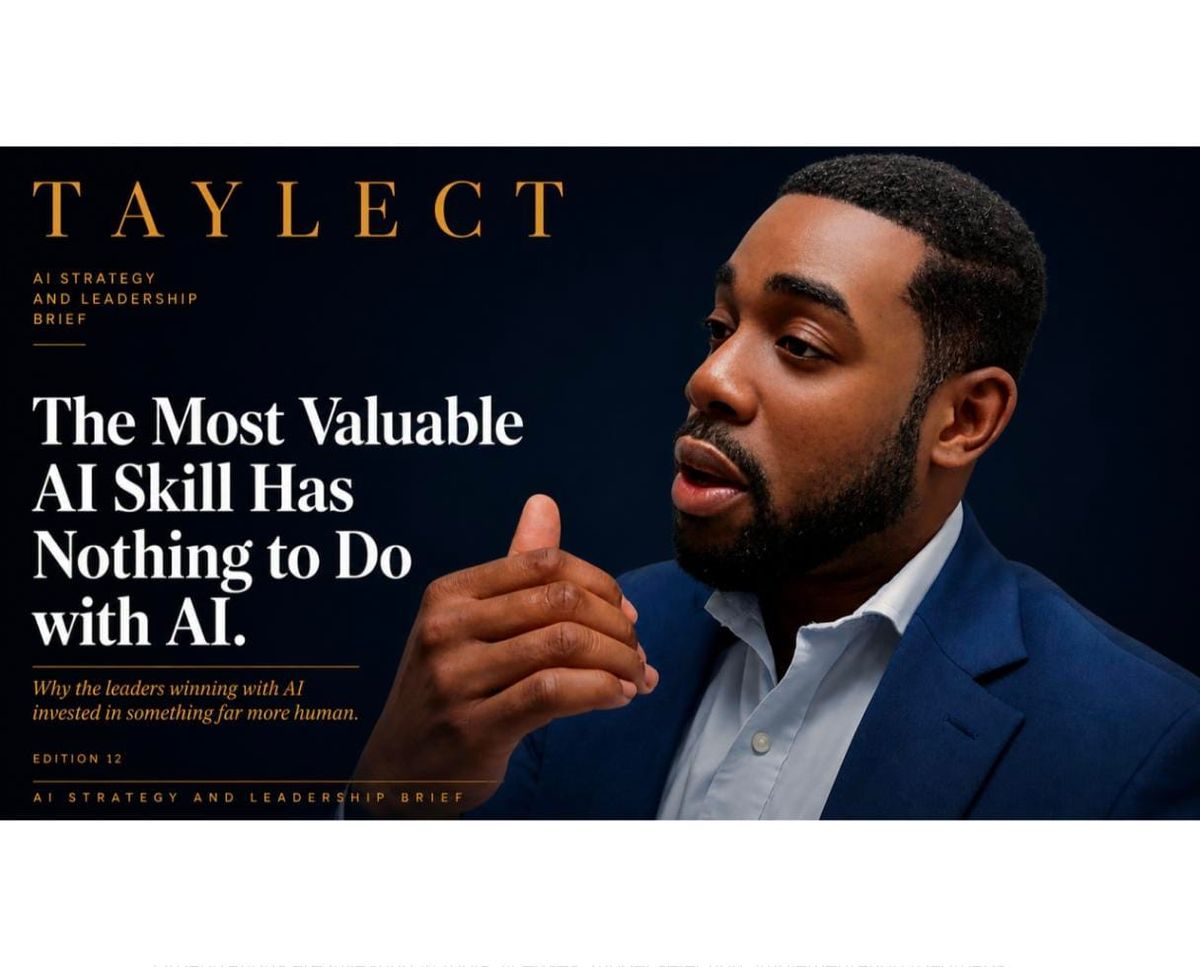
Edition 12 · Where AI Strategy Becomes a Leadership Advantage
Why are the leaders getting the most from artificial intelligence investing in something far more fundamental?
In an era of constant AI noise, leaders don't need more information; they need clarity.
Every conversation about AI capability seems to focus on the wrong thing.
Organizations are investing in tools, licenses, model selection, implementation roadmaps, adoption targets, and usage dashboards.
Almost none of them are investing in the one capability that ultimately determines whether any of those investments create value.
Communication. Critical thinking. Curiosity.
These are not AI skills.
They are human capabilities that predate AI by centuries.
Ironically, AI has made them more valuable than ever.
In a world where artificial intelligence can generate a confident, well-formatted, completely incorrect answer in seconds, the organizations that succeed won't simply have better technology.
They will have better thinkers.
The Real Limiting Factor in AI
Here is a pattern worth paying attention to, regardless of how far along an organization is in its AI journey.
Two people. The same AI tool. The same access. Completely different outcomes.
The difference is almost never technical.
The person creating more value is rarely the one who understands how the model works.
It is the one who communicates with precision, provides meaningful context, and recognizes when an answer is not good enough and why.
That final capability is the most important.
AI delivers outputs with the same confidence whether they are accurate, incomplete, or entirely wrong.
It does not announce uncertainty.
It does not warn you when it has reached the limits of its knowledge.
It simply produces an answer.
The person who pauses, questions it, validates it, and asks a better follow-up question is not demonstrating technical expertise.
They are demonstrating judgment.
Judgment is not developed by AI.
It is developed through years of careful reading, clear communication, disciplined thinking, and intellectual honesty.
You cannot automate your way to that capability.
You have to build it.
Introducing the Taylect 3C Framework
The more I observe high-performing AI users, the more convinced I become that three human capabilities consistently separate them from everyone else.
The Taylect 3C Framework is the individual playbook for thriving in an AI-enabled world. It identifies the three human capabilities that determine how much value any person extracts from any AI tool, regardless of the tool, organization, or industry they operate in.
Communicate. Think Critically. Stay Curious.
C1 — Communicate
The quality of AI output is directly determined by the quality of human input.
Vague instructions produce vague answers.
Generic prompts produce generic outputs.
The professionals who consistently extract exceptional value from AI are rarely writing magical prompts.
They simply communicate exceptionally well.
They define the problem clearly.
They explain the context.
They describe what success looks like before asking the question.
Prompt engineering is a tactic.
Communication is a discipline.
One evolves with today's tools. The other compounds throughout an entire career.
The question leaders should ask is not whether their people know how to use AI.
It is whether their people can clearly articulate what they actually need.
C2 — Think Critically
AI is remarkably good at producing answers that sound convincing.
That is precisely what makes it dangerous.
A polished response is not necessarily a correct response.
A confident answer is not necessarily an accurate one.
The professionals who consistently outperform others are not those who accept AI's first answer.
They are the ones who evaluate it.
They ask where the evidence comes from.
They compare it with what they already know.
They challenge assumptions.
They recognize when something is technically fluent but intellectually weak.
Critical thinking is not skepticism for its own sake.
It is the discipline of asking one simple question before acting on any output.
Is this actually good enough?
That may become the most valuable AI skill any organization develops.
C3 — Stay Curious
Research is a behaviour. Curiosity is a disposition.
You can train someone to follow a research process. You cannot train someone to be genuinely curious about whether the first answer they received is actually the best one.
Curiosity is what makes someone go deeper, verify a claim, explore a second perspective, question an assumption, ask a follow-up question when the output feels slightly off. It is the drive that separates the person who accepts AI's first answer from the person who uses it as a starting point.
In an AI-enabled world, curiosity is also what protects you. AI will confidently cite nonexistent sources, attribute quotes to people who never said them, and present plausible statistics with no verifiable origin. The curious person checks. The incurious person publishes.
Most fundamentally, curiosity is irreducibly human. An AI tool can be directed to research. It cannot be directed to want to know.
That distinction matters more as AI becomes more capable because the human who remains genuinely curious about whether AI is right will always be more valuable than the one who has simply learned to trust it.
The Connection to the Taylect 4R Framework
The 3C Framework and the 4R Framework operate at different levels of the same argument.
The 4R Framework — Rethink, Replicate, Reveal, Refine — is the organizational playbook. It answers the question: how should organizations implement AI thoughtfully and sustainably?
The 3C Framework — Communicate, Think Critically, Stay Curious — is the individual playbook. It answers the question: what capabilities do individuals need to thrive in the organizations that do?
Together, they point to the same conclusion.
The gap between AI adoption and understanding will not close because organizations will keep buying better tools. It will close when organizations invest as seriously in human capability as they do in technical capability.
What This Means for Leaders
The most important AI investment you can make right now is not another platform.
It is strengthening the human capabilities that determine whether those platforms create value.
Communication. Critical thinking. Curiosity.
These are not complementary skills.
They are force multipliers.
Every dollar spent on AI licenses without a corresponding investment in human judgment increases the likelihood of poor adoption, weak outcomes, and disappointing business value.
Technology is rarely the limiting factor.
People are.
The best AI users in your organization are unlikely to be the most technical.
They will be the most articulate.
The most rigorous.
The most genuinely curious.
The people who could write a clear brief before AI existed — and write an even better one because of it.
AI did not create that advantage.
It revealed it.
This Week's Challenge
Think about the people in your organization who consistently get the most value from AI.
What truly separates them?
Technical expertise?
Or something far more human?
Drop your thoughts in the comments. I read everyone.
If this changed how you think about AI capability building, share it with one leader who is currently investing in tools before investing in people.
If you are not yet subscribed to Taylect: taylect.com — every week, one sharp analysis of AI strategy, governance, and leadership. Written from the practitioner's perspective. No hype. Just clarity.
The conversation Canada needs about AI is not happening loudly enough. Taylect is here to change that.
One Resource Worth Your Time
Richard Feynman's approach to learning remains one of the best frameworks for working with AI. His principle was simple: if you cannot explain it simply, you do not understand it well enough. That may also be the best test for every AI-generated answer. Before you trust it, explain it. If you cannot, keep asking.
AI is not a technology race. It is a decision-making advantage.
The organizations that succeed won't be the ones with the most AI. They will be the ones with the best communicators, the best thinkers, and the most curious minds.
Because those organizations will ultimately develop the best judgment.
Execution, not experimentation, will define the next phase of AI.
Dwayne D. Taylor, Senior Manager, Data Products Excellence & Innovation — Scotiabank, MBA Candidate, AI Leadership — University of Fredericton, Publisher, Taylect: AI Strategy and Leadership Brief
The views expressed are my own and do not reflect those of my employer.

Comments ()