The AI Skill Every Senior Leader Thinks They Have — And Almost None of Them Do
Most senior leaders claim AI literacy, but almost none have AI discernment: the rare skill of knowing when to trust an AI output and when to challenge it.
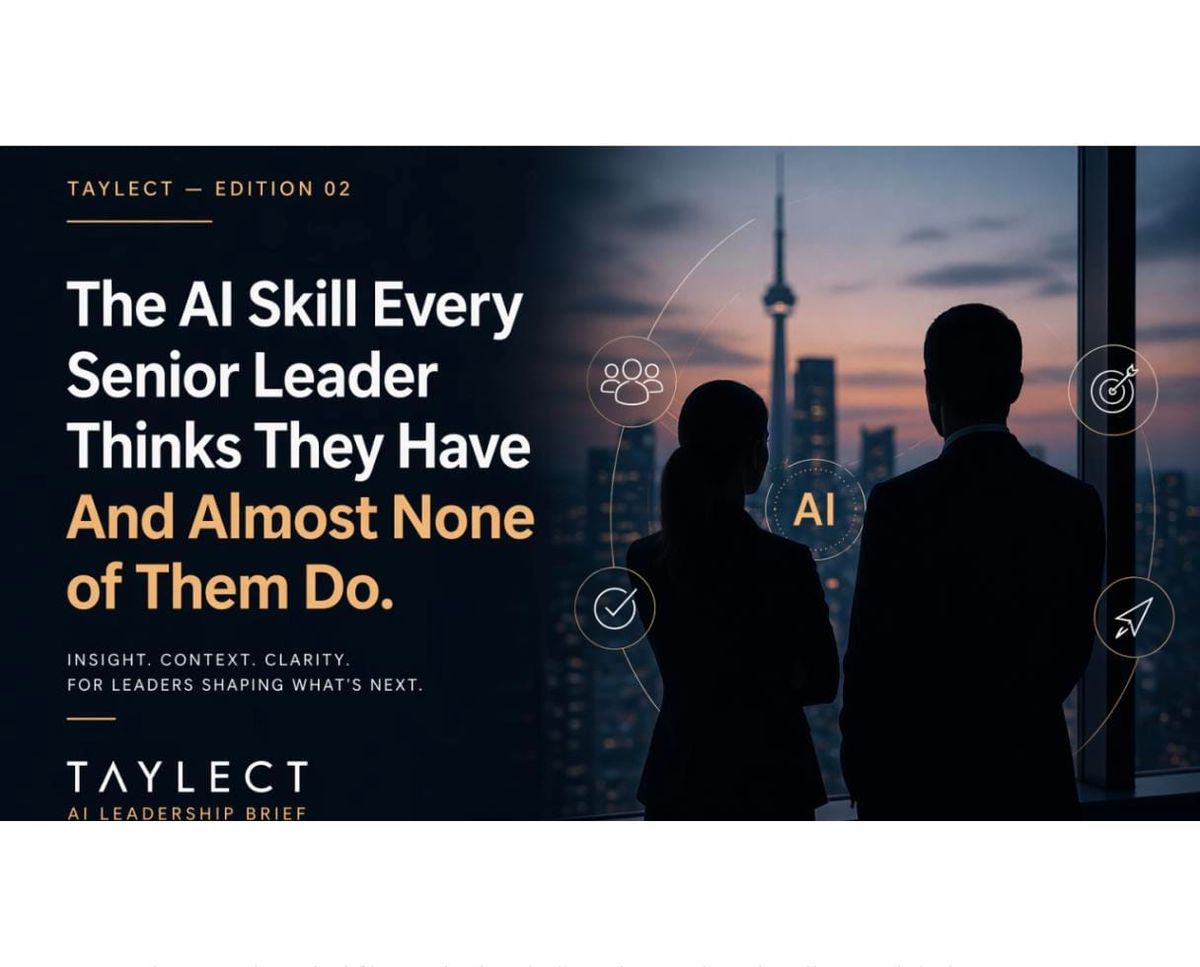
Edition 02 | Where AI strategy becomes a leadership advantage
The essential skill is not prompt engineering or understanding large language models. It is more fundamental, and its absence is already costing organizations in unmeasured ways.
In an era of constant AI noise, leaders don't need more information; they need clarity.
The Uncomfortable Truth
Most senior leaders in 2026 will claim to be AI-literate. They have reviewed reports, attended briefings, observed demonstrations, and approved AI strategies. They discuss transformation, efficiency, and competitive advantage with ease.
However, most cannot ask the right question at the critical moment when faced with an AI-informed decision.
This skill is called AI discernment, and it is currently the rarest capability among leaders.
Only 1% of C-suite leaders describe their organization as having a mature AI deployment where AI is deeply integrated into workflows and generating real business value. (McKinsey State of AI Report, 2025)
Not 10%. Not 20%. One percent.
The gap between AI ambition and execution is not a technology problem. It is a judgment problem.
And judgment is what AI discernment builds.
AI discernment is the ability to evaluate an AI-generated output against its underlying assumptions, constraints, and business context and make a defensible decision in real time.
AI literacy tells you what the technology can do.
AI discernment determines whether you should act on its output.
What Discernment Actually Looks Like
Inside complex institutions, a leader receives a recommendation whether from a model, a team using a model, or a dashboard powered by AI and faces a choice most have never been trained for: how much weight should this carry?
Consider a credit model recommending approval based on historical repayment patterns. A discerning leader asks: Does this data reflect current economic conditions or a pre-inflation environment that no longer exists?
That question alone can change the decision. The leaders who default to the output because the technology produced it are abdicating judgment.
The leaders who dismiss the output because they do not trust the technology are leaving real insight on the table.
Neither is discernment.
Discernment is the capacity to interrogate the output: What data was this trained on? What was it optimized for? Where are the limits of its reliability? What would a wrong answer look like here, and how would we detect it?
These are not technical questions. They are leadership questions.
And most leaders have not been trained to ask them.
Why This Gap Is Widening Right Now
AI has moved from experimentation to infrastructure.
It now shapes decisions across credit, hiring, customer segmentation, risk scoring, and forecasting.
And infrastructure does not get questioned. It gets relied upon.
That is precisely when the absence of discernment becomes a liability.
AI usage is already happening across organizations at leadership levels, with leaders not fully understanding it. Decisions are being influenced daily, often without explicit scrutiny.
When leadership does not actively apply judgment, that vacuum gets filled by assumptions, habit, or the most confident voice in the room.
There is also a regulatory dimension that makes this urgent.
With frameworks like the EU AI Act holding humans accountable for high-risk AI decisions, leaders are directly responsible for outcomes even when those outcomes are shaped by models.
Canada is moving in the same direction.
"The AI recommended it" is not a defensible position.
A leader who can clearly demonstrate they interrogated an AI-driven recommendation — and articulate why they accepted or overrode it — meets both regulatory expectations and leadership standards.
86% of business leaders want more responsible AI training, but over half say their organizations don't adequately educate staff on AI ethics and governance. (StiboSystems / ScienceDirect AI Literacy Development Study, 2024)
The gap is recognized. It is not being closed. And that is a leadership decision.
Three Ways to Build AI Discernment in Your Organization
Standardize interrogation, not adoption. Before acting on any AI-informed output, ask one question: What was this optimized for, and is that what we value?
Make judgment visible. Introduce AI decision logs. Not for compliance but for pattern recognition. Over time, they reveal where leaders over-trust or under-trust AI, and whether either instinct is justified.
Measure decision quality, not tool usage. Adoption is a vanity metric. Instead, ask: Are decisions getting better?
That shift changes what leaders pay attention to and what they develop.
This Week's Question
Reflect on your organization: Is the biggest barrier to effective AI discernment culture, capability, or clarity of ownership? Start a discussion with your team today to identify and address this barrier.
One Resource Worth Your Time
McKinsey's 2025 State of AI Report provides one of the clearest views of where organizations stand, not where they believe they stand.
The gap between those two realities is where most leadership blind spots exist.
Final Thought
AI is not just a technology shift. It is a decision-making shift. Commit now to building discernment and judgment. Begin by leading one focused conversation this week about how your team evaluates AI-driven decisions.
The next phase of AI, weak judgment, will no longer remain hidden.
It will be exposed quickly and at scale.
Dwayne D. Taylor, Senior Manager, Data Product Excellence & Innovation – Scotiabank
MBA (AI-Leadership), Publisher, Taylect: AI Leadership Brief
The views expressed are my own and do not reflect those of my employer.

Comments ()