Microsoft Isn't Building Another AI Assistant. It's Building the Enterprise AI Operating System.
Microsoft's latest Copilot updates aren't just new features they signal a shift from choosing the best AI model to building an enterprise AI operating layer. The competitive advantage is moving from model selection to organizational capability and governance.
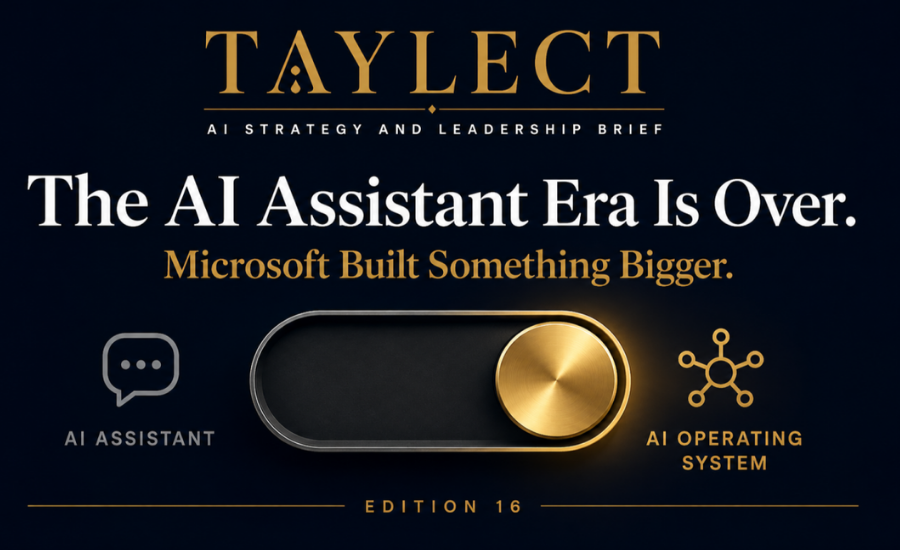
Edition 16 · Where AI Strategy Becomes a Leadership Advantage
A Microsoft announcement may have quietly changed the leadership question organizations should be asking about AI.
Executive Brief
The Signal: Microsoft is building far more than another AI assistant. It is building the infrastructure for enterprise AI — a platform that connects people, organizational knowledge, business processes, governance, and multiple AI models simultaneously.
Why It Matters: AI is becoming organizational infrastructure, not just employee productivity software. This changes the operating model conversation entirely.
The Leadership Decision: The question is no longer which AI tool to deploy. It is becoming how AI becomes part of our operating model — and who is responsible for designing that model.
Strategic Analysis
For the past two years, I have watched organizations debate which AI model to choose.
This week Microsoft made that question feel significantly less important.
The AI conversation has revolved around models. GPT-4. Claude. Gemini. Llama. Organizations have asked which model performs best, which vendor is winning, and which assistant employees should adopt.
Microsoft's recent Copilot announcements suggest those questions are becoming less important.
The company continues expanding Microsoft 365 Copilot into a unified enterprise experience that brings together productivity, coding assistance, AI agents, organizational knowledge, and governance. At the same time, Microsoft is embracing a multi-model strategy by enabling organizations to use different foundation models, including Anthropic's Claude, for different workloads.
Individually, each announcement appears incremental.
Viewed together, they reveal a larger strategic direction.
Microsoft is no longer simply adding AI features.
It is building an enterprise AI operating layer.
Why This Matters
Many organizations are still deploying AI through isolated experiments.
Marketing adopts one platform. Developers use another. Customer service implements a third. Knowledge workers rely on yet another assistant.
Experimentation creates valuable learning.
It rarely creates enterprise capability.
As AI adoption matures, organizations require a consistent approach to identity, governance, permissions, knowledge management, workflows, and increasingly autonomous AI agents.
That is the operating layer Microsoft is building.
The conversation is shifting from AI adoption to AI orchestration.
The Leadership Challenge
For executives, the question is no longer whether to deploy Copilot.
The more important question is: what role should Copilot play in our AI operating model?
Choosing a tool is a technology decision. Designing an operating model is a leadership decision.
Operating models determine how organizations govern AI, manage risk, transform their workforce, develop AI capability, and measure business value.
Those responsibilities belong to leadership, not to the technology team.
Governance as Competitive Advantage
Microsoft's continued investment in governance may prove just as significant as its product announcements.
As organizations begin using multiple AI models through a common interface, governance becomes less about controlling individual models and more about establishing consistent policies, accountability, oversight, and security across the enterprise.
Organizations will increasingly compete on the quality of their AI governance, not simply the sophistication of their chosen models.
Boards and executive teams should view governance as a strategic capability rather than a compliance exercise.
Organizations that establish clear governance frameworks now will scale AI faster and with greater confidence than those relying on ad hoc experimentation.
Taylect Perspective
Microsoft's announcements are easy to interpret as another round of product updates.
That misses the larger story.
The most important shift is not technological. It is organizational.
Competitive advantage is moving away from selecting the best AI model. It is moving toward building the strongest organizational capability around AI.
This pattern has been emerging across every AI implementation I have written about since edition one of this newsletter. The organizations generating real value from AI are not the ones with the most sophisticated models. They are the ones that rethought their workflows before deploying, built governance into their operating model from the start, and treated AI capability as a leadership responsibility rather than a technology project.
Technology enables AI.
Leadership determines whether AI creates enterprise value.
The Taylect 4R Framework
This development reinforces each stage of the Taylect 4R Framework.
Rethink — redesign work before deploying AI. The question is not which tool to deploy. It is what problem the deployment is actually solving and whether the process it will replicate is worth replicating at scale.
Replicate — scale successful workflows consistently across teams. Disconnected experimentation rarely creates enterprise capability. Microsoft's operating layer is essentially a Replicate infrastructure — a consistent environment through which proven workflows can scale.
Reveal — connect organizational knowledge across systems to surface what was previously invisible. The operating layer Microsoft is building makes this possible at enterprise scale. What it reveals about your organization's knowledge gaps, governance maturity, and process quality will be as significant as what it enables.
Refine — continuously improve governance, operating models, and organizational capability as AI adoption matures. The operating model that works at 20% adoption will not be sufficient at 60%.
The Decision
The organizations that succeed over the next several years will not necessarily be those with access to the newest AI models.
They will be those that redesign workflows, strengthen governance, improve knowledge management, and build lasting organizational capability.
The leadership challenge is no longer selecting the right AI assistant.
It is designing the right AI operating model.
Key Insight
The next competitive advantage in AI will not come from choosing the best model. It will come from building the strongest operating system around it.
Boardroom Discussion
If AI became part of your organization's operating model tomorrow, what would need to change first?
Technology. Governance. Leadership. Or culture?
Drop your answer in the comments. I read every one.
If this reframes how you think about enterprise AI strategy, share it with one leader who is still asking which model to choose instead of how to build the capability around it.
Every week, one sharp analysis of AI strategy, governance, and leadership. Written from the practitioner's perspective. No hype. Just clarity.
Continue the Conversation
How is your organization approaching this shift?
Is AI still being deployed as a collection of disconnected tools, or are you building a coherent operating model that can scale across the enterprise?
One Resource Worth Your Time
Microsoft's official documentation on Microsoft 365 Copilot architecture and governance is publicly available at microsoft.com. For any leader evaluating how Copilot fits into a broader enterprise AI strategy, the governance and administrative controls documentation is the most practical starting point; it reveals how Microsoft is thinking about the operating layer problem and what controls exist before you deploy at scale.
AI is not a technology race. It is a decision-making advantage.
The organizations that succeed won't be the ones with the best models. They will be the ones that build the strongest operating system around them.
Execution, not experimentation, will define the next phase of AI.
Dwayne D. Taylor Publisher, Taylect: AI Strategy and Leadership Brief, taylect.com
The views expressed are my own and do not reflect those of my employer.