

Why Canadian Banks Are Better Positioned for AI Than Anyone Is Admitting
RBC ranks third globally for AI maturity. Here is why Canadian banks' governance-first culture is becoming their biggest AI advantage.
Edition 03 | Where AI strategy becomes a leadership advantage
Despite global claims that Canada lags in AI, Canadian banking data paints a different picture. Leaders who recognize this discrepancy gain a strategic edge, as the world is just beginning to notice how Canadian banks leverage their strengths.
In an era of constant AI noise, leaders don't need more information; they need clarity.
The Narrative We Keep Hearing
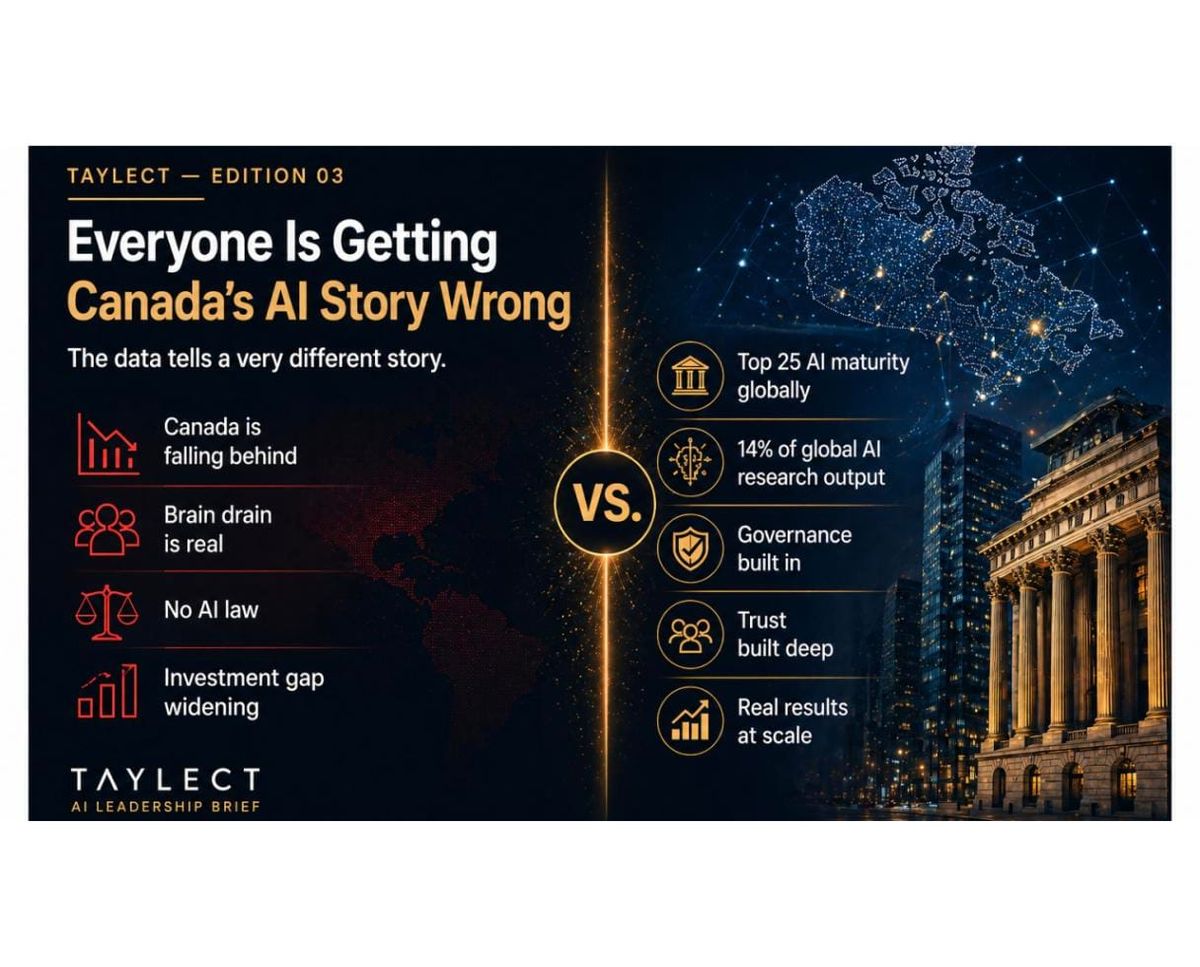
Canada is falling behind on AI. We lack the regulatory framework. We cannot retain our best talent. Our companies are too small to compete with US hyperscalers. The brain drain is real. The investment gap is widening. Every week brings another report, another think piece, another panel discussion reinforcing the same story of national decline.
While there is some truth to the prevailing narrative, it overlooks a critical factor for financial services leaders: a significant shift within Canadian banking that uniquely positions them for success with AI.
Against this backdrop, Canada's banks are quietly building one of the most sophisticated AI infrastructures in the world. Not despite their regulated, risk-managed culture, but because of it.
RBC ranks third globally for AI maturity among the world's 50 largest banks, behind only JPMorgan Chase and Capital One. Canada is the only country where all major banks rank in the top 25 globally. (Evident AI Banking Index, 2025)
Read that again. Not top 25 in North America. Top 25 in the world. For a country whose banks are routinely dismissed as too conservative, too slow, and too regulation-bound to compete in the AI era, that is a remarkable number. And almost nobody outside the industry is talking about it.
Why Governance-Driven Institutions Are Built for AI
Here is what the global AI conversation keeps missing: the qualities that made Canadian banking seem dull are exactly the qualities that make it AI-capable.
Governance infrastructure. Data stewardship discipline. Risk-adjusted decision frameworks. Regulatory compliance culture. Years of investment in enterprise data architecture. These are not obstacles to AI adoption; they are prerequisites for it. And Canadian banks have been building them for decades, while their Silicon Valley counterparts have been optimizing for speed over structure.
Consider what that looks like in practice. When RBC launched its customer insight platform, it leveraged established data lineage protocols, ensuring that every data input could be traced and audited — a requirement that would have stopped most organizations in their tracks. Canadian banks have already cleared that bar. They are not building the foundation. They are building on top of it.
The AI-first companies that disrupted finance are now scrambling to retrofit governance, build trust frameworks, and navigate regulatory scrutiny they never anticipated. Canadian banks already have the scaffolding.
The discipline that characterizes Canadian banking, often seen as boring, is precisely what makes it ready for AI. Governance is not a limitation on AI; it's the essential foundation for AI advantage.
The Investments Are Real and Compounding
This advantage is not just theoretical; the numbers are concrete and accelerating.
RBC spends $6 billion annually on technology, with $2 billion dedicated specifically to AI systems and operational modernization. The bank expects to generate between $700M and $1B in enterprise value from AI by 2027. (RBC Investor Day, March 2026 / Globe and Mail)
TD Bank's Layer 6 AI lab has been operational since 2018 and recently launched TD AI Prism, a model that analyzes a customer's entire portfolio simultaneously to predict future product needs. RBC's ATOM model is improving credit underwriting in ways that expand the client base, not just cut costs. BMO's Lumi AI assistant draws instantly from over 8,000 internal policies. Scotiabank is rolling out assistive AI tools across its workforce as part of a broader modernization push.
These are not pilot programs. These are production systems operating at scale within regulated institutions, which means they have already cleared the governance, compliance, and risk management bars that most organizations have not yet begun to address.
Despite their smaller relative size globally, Canada's Big Five banks account for 14% of global AI research output and 9% of AI patents among the world's 50 largest banks. (Evident AI Banking Index via Globe and Mail, 2025)
The Real Competitive Advantage Hiding in Plain Sight
The most underappreciated element of Canada's banking AI story is not the investment. It is the trust infrastructure.
Canadian banks operate in one of the highest-trust financial environments in the world. Customers share data, accept personalized recommendations, and engage with AI-assisted services precisely because they trust the institution behind them. That trust was not built by an algorithm — it was built over decades of governance, accountability, and regulatory discipline.
In an era where AI trust is becoming a genuine competitive differentiator, where customers, regulators, and boards are asking harder questions about how AI decisions are made, the institutions that can credibly answer those questions will win. Canadian banks can answer them. Many of their global competitors cannot.
This is the core argument missing from the "Canada is falling behind" story. AI competition is not solely about rapid deployment. It's about building systems that earn real trust and inform meaningful decisions. In this crucial aspect, Canada leads.
Three Implications for Leaders Right Now
Stop treating your governance infrastructure as a cost centre. The compliance frameworks, risk management processes, and data stewardship practices your organization has built are AI assets; they are what allow you to deploy AI at scale without the reputational and regulatory exposure that less-disciplined organizations face. Make that case explicitly to your board.
Reframe the talent conversation internally. The AI talent that stays in Canada is building systems inside some of the world's most complex regulated environments. That experience is not less than building consumer apps in many ways; it is harder, and it produces governance expertise that Silicon Valley is now desperately trying to acquire.
Use Canada's banking AI story as a template for your own organization's AI narrative. The argument that discipline enables AI advantage is one you can make internally right now. Organizations that position governance investments as competitive infrastructure — not compliance overhead — will attract better AI talent, build more trusted systems, and move faster in the long run.
This Week's Question
Does your organization treat its governance and compliance infrastructure as an AI asset or an AI obstacle, and what would change if you shifted that frame? Challenge your team to rethink governance and compliance as strategic AI assets. Commit to identifying one action this week to shift that perspective and drive AI readiness.
One Resource Worth Your Time
Evident's 2025 AI Banking Index is the most rigorous independent benchmark of where global banks stand on AI maturity, measured across talent, innovation, leadership, and transparency. The Canada story buried inside this report is more compelling than most national AI strategy documents being published right now. Available free at evidentinsights.com.
AI is not a technology race. It is a decision-making advantage. The winners in AI won't have better models. They'll have better discipline. Execution, not experimentation, will define the next phase of AI.
Dwayne D. Taylor
Senior Manager, Data Products Excellence & Innovation, Scotiabank
MBA Candidate, AI Leadership — University of Fredericton, Publisher, Taylect: AI Strategy and Leadership Brief
The views expressed are my own and do not reflect those of my employer.


Comments ()